
Sign Up
Thank you for Submitting!
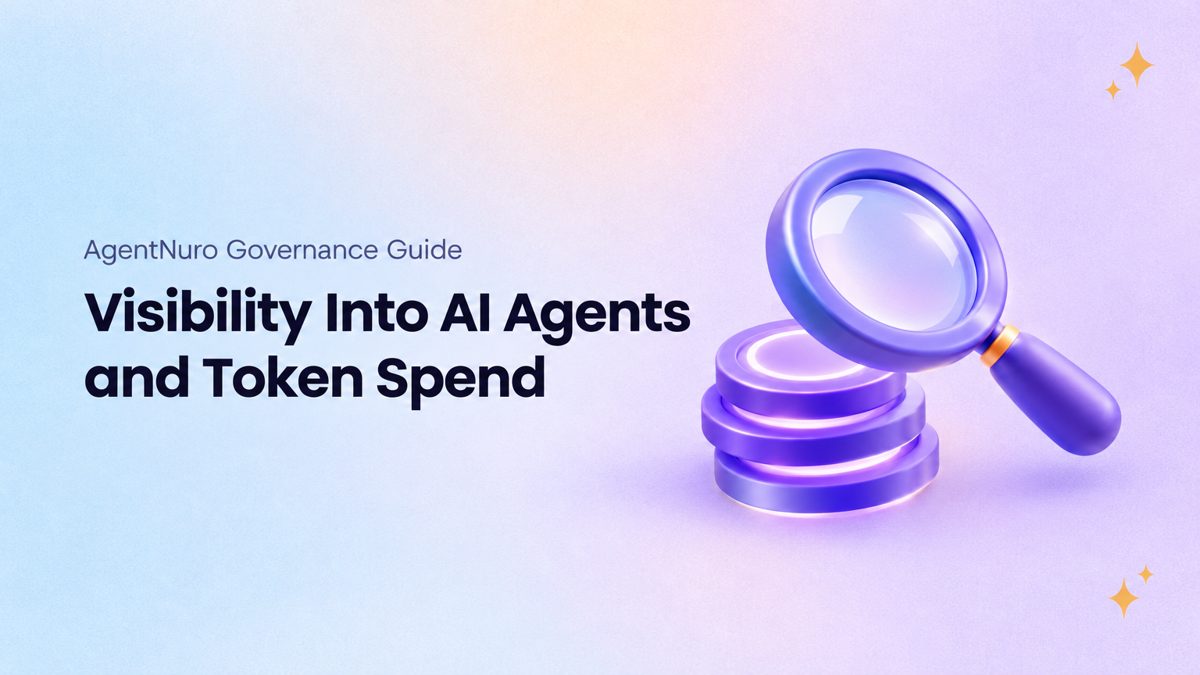
AI agent visibility is the ability to name every AI agent running in the enterprise, who owns it, which models it calls, and what its tokens cost.
Most enterprises do not have it yet: 82% discovered previously unknown AI agents in their environment during the past year, and only 21% maintain a real-time agent inventory.
This guide shows how AgentNuro builds that visibility in four steps (discover, attribute, control, optimize) and gives you an owner-by-owner governance checklist to run it.
82% of enterprises found AI agents in their environment last year that nobody knew were there, and 41% found them more than once.
Gaining visibility into AI agents and token spend is harder than tracking SaaS seats, because agents are created in minutes, call several models, and bill by consumption rather than by license.
Engineering picks the model, IT finds out after the fact, and Finance pays the bill. CIOs ask what is running, CFOs ask whose budget pays for it, and FinOps leads ask who owns each token.
The answer is the discipline described in CloudNuro's guide to TokenOps as a FinOps practice for the token economy: treat every agent as an asset with an owner and every token as a cost with a cost center.
This guide explains what full visibility means, how AgentNuro delivers it, and the governance steps that keep it accurate.
Find sanctioned and shadow AI agents across your enterprise, read-only, with nothing changed in your apps.
Request a DemoFull visibility means four questions have a current, auditable answer for every agent: what is it, who owns it, which models and data does it touch, and what does it cost per month in tokens. If any one is missing, the agent is ungoverned.
Visibility is the first layer. Without it, budgets, policies, and ROI reviews rest on the agents someone remembered to register.
A SaaS application shows up as a license. An agent shows up as API calls, so license-based inventories miss it entirely.
Token consumption, not seat count, drives the bill. One looping agent can consume a month of budget in a day.
Agents hold credentials and act on data without a person in the loop. CloudNuro's analysis of the shadow AI agent problem explains why existing identity controls miss them.
43% of organizations have implemented AI usage or token budgets. A budget without attribution tells Finance the total, but not which agent or cost center caused it.
AgentNuro is CloudNuro's Enterprise AI Adoption Management platform. It moves every AI dollar through four steps, from finding agents to improving the value each token returns.

AgentNuro finds every AI tool, agent, subscription, and model, including those nobody registered, across usage, billing, and identity data. It connects read-only through provider, billing, and identity APIs, so nothing changes in your apps.
CloudNuro's published claim is that teams connect in minutes and see insights the next day. The difference between this read-only layer and enforcement is covered in AgentNuro Insight vs Control.
AgentNuro maps every dollar and token to a user, project, model, agent, and business unit. That turns a single provider invoice into a cost allocation Finance can act on, as shown in how AgentNuro attributes AI budgets.
With attribution in place, AgentNuro applies real-time controls to models, budgets, and policies. The layered approach to AI budget controls that stop runaway spending explains how each budget gets an owner and a ceiling.
AgentNuro tracks value per token, not only cost per token, and shows whether the right model is doing the work. CloudNuro's answer to what AgentNuro does for CIOs and CFOs covers this ROI view in detail.
Replace self-reported registers with continuous discovery from usage, billing, and identity data. It worked when the inventory updates without anyone filing a form.
Every agent needs a named human owner and a cost center. An agent with no owner goes to a review queue, not to production.
Start with monthly showback by business unit, then move to weekly reporting by agent once data is trusted. The approach mirrors building an AI usage monitoring dashboard.
Give each owner a token budget, an alert threshold, and an approved model list. Where routing decisions matter, compare the layers described in model router vs AI gateway.
Retire agents whose cost outpaces their outcome, and move steady workloads to lower-cost models. Larger enterprises formalize this in an AI token management office.
| Step | Owner | Sign it is working |
|---|---|---|
| Living agent inventory | CIO / IT | New agents appear without manual registration |
| Accountable owner | Business unit leads | No production agent lacks an owner and cost center |
| Token spend attribution | FinOps lead | Every invoice line maps to an agent and business unit |
| Budgets and model policies | CFO / CISO | Alerts fire before overruns, not after |
| Value per token review | AI leader | Each agent has a cost and an outcome on record |
See how AgentNuro maps token spend to users, agents, projects and business units.
Request a DemoRegisters capture the agents teams remember, which is why so many enterprises keep finding unknown ones.
Solution: Discover agents from usage, billing, and identity data continuously.
A separate AI ledger hides overlap with SaaS subscriptions and cloud commitments.
Solution: Put AI beside SaaS and cloud in one view, the model behind FinOps beyond cloud.
Blocking agents without knowing who owns them stalls teams and pushes usage further out of sight.
Solution: Attribute first, then set budgets and policies per owner.
AI agent visibility is a current, auditable record of every AI agent in the enterprise, its owner, the models it calls, and its token cost. It is the base layer for AI governance, budgets, and ROI review.
You track token spend by team by mapping each API call to a user, agent, project, and business unit. AgentNuro performs this mapping automatically from provider, billing, and identity data.
A shadow AI agent is an agent running without IT approval or registration. It consumes tokens and touches data outside any governance process until discovery finds it.
AgentNuro's visibility layer is read-only, so nothing changes in your apps. Teams that want enforcement add real-time controls for models, budgets, and policies later.
CloudNuro's published claim is that AgentNuro connects in minutes with insights the next day. The steps are outlined in how to get started with AgentNuro.
Yes. AgentNuro attributes Copilot spend to users, projects, and business units and places it beside other AI spend, as covered in Copilot Studio agent governance with AgentNuro.
AI agents now appear faster than any register can track, and their costs arrive as consumption rather than seats.
Enterprises that skip visibility end up budgeting for totals they cannot explain and enforcing policies on agents they cannot see.
The better model gives every agent an owner and every token a cost center, in one governed view of SaaS, cloud, and AI.
Get a no-cost assessment of where your AI agent and token budget is going.
Get Free Savings AssessmentCloudNuro, through AgentNuro, finds every sanctioned and shadow AI agent, maps each token to a user, agent, project, and business unit, and applies real-time controls to models, budgets, and policies.
It sits on the same platform CloudNuro uses for SaaS management and cloud FinOps, alongside capabilities such as the AI Custodian, so AI spend is governed with the same financial discipline as the rest of the technology estate.
CloudNuro is a leader in Enterprise AI Adoption Management, providing enterprises with unmatched visibility, governance, and cost optimization. Recognized twice in a row by Gartner in the SaaS Management Platforms and named a Leader in the Info-Tech SoftwareReviews Data Quadrant, CloudNuro is trusted by global enterprises and government agencies to bring financial discipline to SaaS, cloud, and AI. Trusted by enterprises, CloudNuro provides centralized SaaS inventory, license optimization, and renewal management along with advanced cost allocation and chargeback, giving IT and Finance leaders the visibility, control, and cost-conscious culture needed to drive financial discipline.
Request a no cost, no obligation free assessment —just 15 minutes to savings!
Get StartedAI agent visibility is the ability to name every AI agent running in the enterprise, who owns it, which models it calls, and what its tokens cost.
Most enterprises do not have it yet: 82% discovered previously unknown AI agents in their environment during the past year, and only 21% maintain a real-time agent inventory.
This guide shows how AgentNuro builds that visibility in four steps (discover, attribute, control, optimize) and gives you an owner-by-owner governance checklist to run it.
82% of enterprises found AI agents in their environment last year that nobody knew were there, and 41% found them more than once.
Gaining visibility into AI agents and token spend is harder than tracking SaaS seats, because agents are created in minutes, call several models, and bill by consumption rather than by license.
Engineering picks the model, IT finds out after the fact, and Finance pays the bill. CIOs ask what is running, CFOs ask whose budget pays for it, and FinOps leads ask who owns each token.
The answer is the discipline described in CloudNuro's guide to TokenOps as a FinOps practice for the token economy: treat every agent as an asset with an owner and every token as a cost with a cost center.
This guide explains what full visibility means, how AgentNuro delivers it, and the governance steps that keep it accurate.
Find sanctioned and shadow AI agents across your enterprise, read-only, with nothing changed in your apps.
Request a DemoFull visibility means four questions have a current, auditable answer for every agent: what is it, who owns it, which models and data does it touch, and what does it cost per month in tokens. If any one is missing, the agent is ungoverned.
Visibility is the first layer. Without it, budgets, policies, and ROI reviews rest on the agents someone remembered to register.
A SaaS application shows up as a license. An agent shows up as API calls, so license-based inventories miss it entirely.
Token consumption, not seat count, drives the bill. One looping agent can consume a month of budget in a day.
Agents hold credentials and act on data without a person in the loop. CloudNuro's analysis of the shadow AI agent problem explains why existing identity controls miss them.
43% of organizations have implemented AI usage or token budgets. A budget without attribution tells Finance the total, but not which agent or cost center caused it.
AgentNuro is CloudNuro's Enterprise AI Adoption Management platform. It moves every AI dollar through four steps, from finding agents to improving the value each token returns.
AgentNuro finds every AI tool, agent, subscription, and model, including those nobody registered, across usage, billing, and identity data. It connects read-only through provider, billing, and identity APIs, so nothing changes in your apps.
CloudNuro's published claim is that teams connect in minutes and see insights the next day. The difference between this read-only layer and enforcement is covered in AgentNuro Insight vs Control.
AgentNuro maps every dollar and token to a user, project, model, agent, and business unit. That turns a single provider invoice into a cost allocation Finance can act on, as shown in how AgentNuro attributes AI budgets.
With attribution in place, AgentNuro applies real-time controls to models, budgets, and policies. The layered approach to AI budget controls that stop runaway spending explains how each budget gets an owner and a ceiling.
AgentNuro tracks value per token, not only cost per token, and shows whether the right model is doing the work. CloudNuro's answer to what AgentNuro does for CIOs and CFOs covers this ROI view in detail.
Replace self-reported registers with continuous discovery from usage, billing, and identity data. It worked when the inventory updates without anyone filing a form.
Every agent needs a named human owner and a cost center. An agent with no owner goes to a review queue, not to production.
Start with monthly showback by business unit, then move to weekly reporting by agent once data is trusted. The approach mirrors building an AI usage monitoring dashboard.
Give each owner a token budget, an alert threshold, and an approved model list. Where routing decisions matter, compare the layers described in model router vs AI gateway.
Retire agents whose cost outpaces their outcome, and move steady workloads to lower-cost models. Larger enterprises formalize this in an AI token management office.
| Step | Owner | Sign it is working |
|---|---|---|
| Living agent inventory | CIO / IT | New agents appear without manual registration |
| Accountable owner | Business unit leads | No production agent lacks an owner and cost center |
| Token spend attribution | FinOps lead | Every invoice line maps to an agent and business unit |
| Budgets and model policies | CFO / CISO | Alerts fire before overruns, not after |
| Value per token review | AI leader | Each agent has a cost and an outcome on record |
See how AgentNuro maps token spend to users, agents, projects and business units.
Request a DemoRegisters capture the agents teams remember, which is why so many enterprises keep finding unknown ones.
Solution: Discover agents from usage, billing, and identity data continuously.
A separate AI ledger hides overlap with SaaS subscriptions and cloud commitments.
Solution: Put AI beside SaaS and cloud in one view, the model behind FinOps beyond cloud.
Blocking agents without knowing who owns them stalls teams and pushes usage further out of sight.
Solution: Attribute first, then set budgets and policies per owner.
AI agent visibility is a current, auditable record of every AI agent in the enterprise, its owner, the models it calls, and its token cost. It is the base layer for AI governance, budgets, and ROI review.
You track token spend by team by mapping each API call to a user, agent, project, and business unit. AgentNuro performs this mapping automatically from provider, billing, and identity data.
A shadow AI agent is an agent running without IT approval or registration. It consumes tokens and touches data outside any governance process until discovery finds it.
AgentNuro's visibility layer is read-only, so nothing changes in your apps. Teams that want enforcement add real-time controls for models, budgets, and policies later.
CloudNuro's published claim is that AgentNuro connects in minutes with insights the next day. The steps are outlined in how to get started with AgentNuro.
Yes. AgentNuro attributes Copilot spend to users, projects, and business units and places it beside other AI spend, as covered in Copilot Studio agent governance with AgentNuro.
AI agents now appear faster than any register can track, and their costs arrive as consumption rather than seats.
Enterprises that skip visibility end up budgeting for totals they cannot explain and enforcing policies on agents they cannot see.
The better model gives every agent an owner and every token a cost center, in one governed view of SaaS, cloud, and AI.
Get a no-cost assessment of where your AI agent and token budget is going.
Get Free Savings AssessmentCloudNuro, through AgentNuro, finds every sanctioned and shadow AI agent, maps each token to a user, agent, project, and business unit, and applies real-time controls to models, budgets, and policies.
It sits on the same platform CloudNuro uses for SaaS management and cloud FinOps, alongside capabilities such as the AI Custodian, so AI spend is governed with the same financial discipline as the rest of the technology estate.
CloudNuro is a leader in Enterprise AI Adoption Management, providing enterprises with unmatched visibility, governance, and cost optimization. Recognized twice in a row by Gartner in the SaaS Management Platforms and named a Leader in the Info-Tech SoftwareReviews Data Quadrant, CloudNuro is trusted by global enterprises and government agencies to bring financial discipline to SaaS, cloud, and AI. Trusted by enterprises, CloudNuro provides centralized SaaS inventory, license optimization, and renewal management along with advanced cost allocation and chargeback, giving IT and Finance leaders the visibility, control, and cost-conscious culture needed to drive financial discipline.
Request a no cost, no obligation free assessment - just 15 minutes to savings!
Get StartedWe're offering complimentary ServiceNow license assessments to only 25 enterprises this quarter who want to unlock immediate savings without disrupting operations.
Get Free AssessmentGet Started




CloudNuro Corp
1755 Park St. Suite 207
Naperville, IL 60563
Phone : +1-630-277-9470
Email: info@cloudnuro.com







Recognized Leader in SaaS Management Platforms by Info-Tech SoftwareReviews