
Sign Up
Thank you for Submitting!
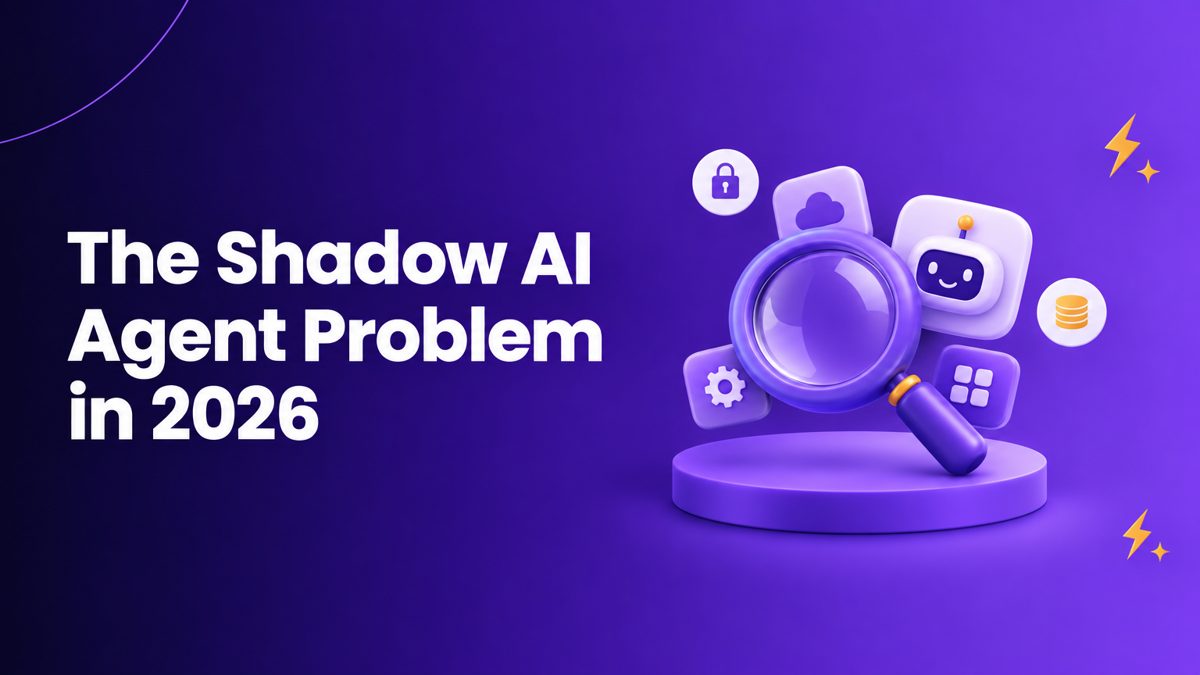
Shadow AI agents are autonomous or semi-autonomous AI agents that run inside an enterprise without IT approval, a named owner, or ongoing monitoring.
In 2026, 29% of employees report using unsanctioned AI agents for work, and only 13% of organizations believe they have appropriate AI agent governance in place.
This post explains why agents are harder to govern than shadow AI apps, who should own them, and a five-stage model for moving every agent from unknown to governed.
The average large enterprise is projected to grow from fewer than 15 AI agents in 2025 to more than 150,000 by 2028.
That growth is already producing a shadow AI agent problem: more than 80% of the largest enterprises run active agents built with low-code and no-code tools, and many of those agents have no owner on record. Most organizations first met this risk as shadow AI, the use of unauthorized AI tools. Agents raise the stakes because they act, not just answer.
CIOs ask what is actually running. CISOs ask what those agents can reach. CFOs ask whose budget pays for the tokens they consume.
This post defines the shadow AI agent problem, explains why existing controls miss it, and lays out how to assign every agent an owner, a cost, and a set of guardrails.
A shadow AI agent is an AI agent that operates without a documented owner, inventory record, access review, or lifecycle process. It can be built on an unsanctioned tool, or on a sanctioned platform that no one is monitoring.
That second category matters most. Approving a low-code agent builder is not the same as governing the agents employees build with it.
A shadow AI app answers a prompt. A shadow AI agent holds credentials, calls tools, reads and writes business records, and consumes tokens on a schedule, often after the person who built it has moved on.
Low-code builders let a sales operations analyst or an HR coordinator ship an agent in an afternoon. Central review processes were designed for dozens of applications per year, not thousands of agents per quarter.
Discovery methods that look for unknown domains or new SaaS subscriptions miss agents that live inside tenants IT already approved. One organization found approximately 44,000 agents in its corporate tenant once it looked. The shadow AI blindspot is now inside the approved stack as well as outside it.
An agent often inherits its creator's broad permissions rather than a least-privilege identity of its own. When an agent writes to a record, the audit log may show that something acted without showing which team or business process owns it.
A chat user stops when they close the tab. An agent runs on triggers, retries on failure, and calls models on every step. Without cost allocation, that spend lands on a shared API key or a central AI budget with no cost center attached, a gap explained in CloudNuro's guide to TokenOps and the token economy.
See how AgentNuro discovers agents and maps them to owners and spend: request a demo.
In most enterprises today, no single team monitors unapproved AI agents end to end. Security sees access events, IT sees platform licenses, and Finance sees an invoice, but none of them holds one inventory that ties each agent to an owner, its permissions, and its cost.
| Role | Their question about agents | What they usually see today | What they need |
|---|---|---|---|
| CIO | How many agents are running, and on which platforms? | Platform license counts | One inventory of sanctioned and unsanctioned agents |
| CISO | What data and systems can each agent reach? | Identity and access events | Agent-level permissions tied to a named owner |
| CFO | Whose budget pays for this agent's tokens? | A provider invoice | Spend by agent, project, and cost center |
| AI leader | Which agents deliver value worth scaling? | Anecdotes from teams | Usage and cost data per agent |
This fragmentation is the core of the CIO's blind spot on invisible AI usage. Each team holds a partial view, and agents fall in the gaps between them.
Agents granted broad connectors can read customer records, contracts, or financial data far beyond their task. Without a permission review, nobody knows the exposure until an incident surfaces it.
When an employee leaves, their SaaS accounts are deprovisioned, but their agents may keep running on stored credentials. An orphaned agent has access, a schedule, and a token budget, and no one accountable for it.
Unregistered agents are rarely tested, logged consistently, or recertified. Compliance teams cannot attest to controls over systems they cannot list.
Token consumption from shadow agents rolls into a central bill. Finance cannot run showback or chargeback, and AI leaders cannot calculate return on investment without a cost denominator per agent.
For the wider context, CloudNuro's roundup of shadow AI statistics every CISO should know covers the broader adoption data.
AgentNuro is CloudNuro's Enterprise AI Adoption Management platform. It moves every AI tool and agent through four stages: discover, attribute, govern, and optimize.
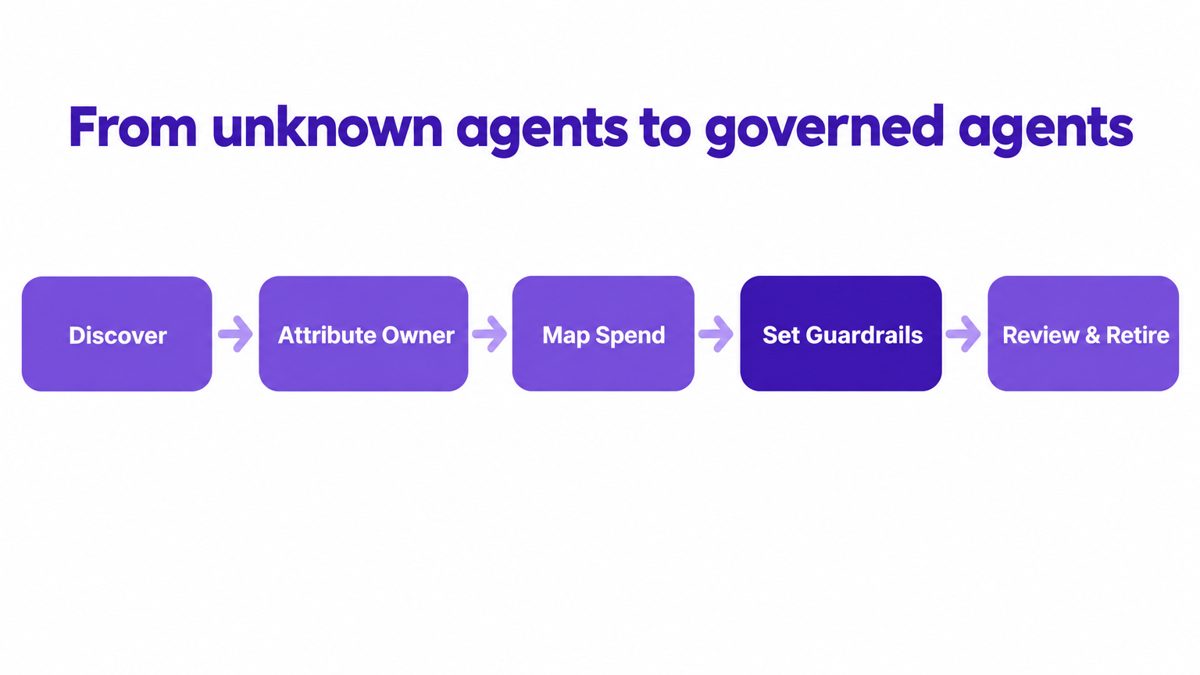
AgentNuro finds sanctioned and shadow AI across OpenAI, Claude, Gemini, Copilot, and other providers. Discovery is read-only, with no agents to install and no application changes, as described in what AgentNuro does for CIOs, CFOs, and CISOs.
AgentNuro maps every dollar and token to a user, project, model, agent, and business unit. An agent without an owner becomes visible as exactly that: a cost with no cost center.
AgentNuro gives real-time control over model choice, data exposure, token consumption, and runaway spend. Policy moves from a written document to an enforced guardrail.
With spend attributed per agent, teams can compare value per token, not only cost per token, and retire agents that consume budget without delivering results.
AgentNuro is built on CloudNuro's SaaS and cloud FinOps foundation, so AI agents sit in the same control plane as the applications and cloud accounts they run on. CloudNuro's AI Custodian extends the same governance model.
AgentNuro connects in minutes and delivers insights the next day. Start with a free savings assessment.
Record every agent's owner, purpose, data sources, permissions, platform, and last review date. CloudNuro's guide to building an AI usage monitoring dashboard shows how to start.
An agent without both is unsanctioned by definition, regardless of the platform it was built on.
Issue agent-specific identities instead of letting agents inherit their creator's full access.
When an owner leaves, reassign or retire their agents in the same workflow that removes their SaaS access.
Employees bypass controls when sanctioned tools do not meet their needs. Approval processes built for thousands of agents keep builders inside the governed path, a principle covered in governing AI agents at enterprise scale.
Manual approval cannot keep pace with growth from fewer than 15 agents to more than 150,000. Agent governance will shift to continuous discovery, automated attribution, and runtime guardrails, managed in the same layer as SaaS and cloud spend.
CloudNuro's view of the next 24 months of enterprise AI governance describes that roadmap in more detail.
A shadow AI agent is an AI agent running without IT approval, a named owner, or ongoing monitoring. It can live on an unsanctioned tool or inside an approved platform that no one reviews.
Shadow AI agents differ from shadow AI tools because they act autonomously: they hold credentials, call other systems, and consume tokens on a schedule. That makes their access and cost risk continuous rather than per session.
In 2026, 29% of employees report using unsanctioned AI agents for work tasks. Only 13% of organizations believe they have appropriate AI agent governance in place.
AI agent governance should be owned jointly by IT, Security, and Finance, working from one shared inventory. Each agent also needs a named business owner and a cost center.
You can discover shadow AI agents with read-only discovery that connects to AI providers and platforms rather than installing software on endpoints. AgentNuro works this way, with no agents and no application changes; see why enterprises need an AI governance strategy for shadow AI.
AI agent spend can be allocated to departments once every token is attributed to a user, project, model, and agent. AgentNuro maps spend to business units so Finance can run showback or chargeback.
The shadow AI agent problem has moved from a policy discussion to an operating reality. Agents now act on business data and spend money continuously, often without anyone accountable for them.
Organizations that rely on separate security, IT, and finance views will keep discovering agents after the incident or the invoice. The better model is unified visibility and accountability across SaaS, cloud, and AI, where every agent has an owner, a cost, and an enforced guardrail.
AgentNuro, CloudNuro's Enterprise AI Adoption Management platform, discovers sanctioned and shadow AI agents, attributes every token to an owner and business unit, and enforces real-time controls on models, data exposure, and spend. Because it runs on CloudNuro's SaaS and cloud FinOps foundation, IT, Security, and Finance work from one source of truth.
CloudNuro is a leader in Enterprise AI Adoption Management, providing enterprises with unmatched visibility, governance, and cost optimization. Recognized twice in a row by Gartner in the SaaS Management Platforms and named a Leader in the Info-Tech SoftwareReviews Data Quadrant, CloudNuro is trusted by global enterprises and government agencies to bring financial discipline to SaaS, cloud, and AI. Trusted by enterprises, CloudNuro provides centralized SaaS inventory, license optimization, and renewal management along with advanced cost allocation and chargeback, giving IT and Finance leaders the visibility, control, and cost-conscious culture needed to drive financial discipline.
Request a no cost, no obligation free assessment —just 15 minutes to savings!
Get StartedShadow AI agents are autonomous or semi-autonomous AI agents that run inside an enterprise without IT approval, a named owner, or ongoing monitoring.
In 2026, 29% of employees report using unsanctioned AI agents for work, and only 13% of organizations believe they have appropriate AI agent governance in place.
This post explains why agents are harder to govern than shadow AI apps, who should own them, and a five-stage model for moving every agent from unknown to governed.
The average large enterprise is projected to grow from fewer than 15 AI agents in 2025 to more than 150,000 by 2028.
That growth is already producing a shadow AI agent problem: more than 80% of the largest enterprises run active agents built with low-code and no-code tools, and many of those agents have no owner on record. Most organizations first met this risk as shadow AI, the use of unauthorized AI tools. Agents raise the stakes because they act, not just answer.
CIOs ask what is actually running. CISOs ask what those agents can reach. CFOs ask whose budget pays for the tokens they consume.
This post defines the shadow AI agent problem, explains why existing controls miss it, and lays out how to assign every agent an owner, a cost, and a set of guardrails.
A shadow AI agent is an AI agent that operates without a documented owner, inventory record, access review, or lifecycle process. It can be built on an unsanctioned tool, or on a sanctioned platform that no one is monitoring.
That second category matters most. Approving a low-code agent builder is not the same as governing the agents employees build with it.
A shadow AI app answers a prompt. A shadow AI agent holds credentials, calls tools, reads and writes business records, and consumes tokens on a schedule, often after the person who built it has moved on.
Low-code builders let a sales operations analyst or an HR coordinator ship an agent in an afternoon. Central review processes were designed for dozens of applications per year, not thousands of agents per quarter.
Discovery methods that look for unknown domains or new SaaS subscriptions miss agents that live inside tenants IT already approved. One organization found approximately 44,000 agents in its corporate tenant once it looked. The shadow AI blindspot is now inside the approved stack as well as outside it.
An agent often inherits its creator's broad permissions rather than a least-privilege identity of its own. When an agent writes to a record, the audit log may show that something acted without showing which team or business process owns it.
A chat user stops when they close the tab. An agent runs on triggers, retries on failure, and calls models on every step. Without cost allocation, that spend lands on a shared API key or a central AI budget with no cost center attached, a gap explained in CloudNuro's guide to TokenOps and the token economy.
See how AgentNuro discovers agents and maps them to owners and spend: request a demo.
In most enterprises today, no single team monitors unapproved AI agents end to end. Security sees access events, IT sees platform licenses, and Finance sees an invoice, but none of them holds one inventory that ties each agent to an owner, its permissions, and its cost.
| Role | Their question about agents | What they usually see today | What they need |
|---|---|---|---|
| CIO | How many agents are running, and on which platforms? | Platform license counts | One inventory of sanctioned and unsanctioned agents |
| CISO | What data and systems can each agent reach? | Identity and access events | Agent-level permissions tied to a named owner |
| CFO | Whose budget pays for this agent's tokens? | A provider invoice | Spend by agent, project, and cost center |
| AI leader | Which agents deliver value worth scaling? | Anecdotes from teams | Usage and cost data per agent |
This fragmentation is the core of the CIO's blind spot on invisible AI usage. Each team holds a partial view, and agents fall in the gaps between them.
Agents granted broad connectors can read customer records, contracts, or financial data far beyond their task. Without a permission review, nobody knows the exposure until an incident surfaces it.
When an employee leaves, their SaaS accounts are deprovisioned, but their agents may keep running on stored credentials. An orphaned agent has access, a schedule, and a token budget, and no one accountable for it.
Unregistered agents are rarely tested, logged consistently, or recertified. Compliance teams cannot attest to controls over systems they cannot list.
Token consumption from shadow agents rolls into a central bill. Finance cannot run showback or chargeback, and AI leaders cannot calculate return on investment without a cost denominator per agent.
For the wider context, CloudNuro's roundup of shadow AI statistics every CISO should know covers the broader adoption data.
AgentNuro is CloudNuro's Enterprise AI Adoption Management platform. It moves every AI tool and agent through four stages: discover, attribute, govern, and optimize.
AgentNuro finds sanctioned and shadow AI across OpenAI, Claude, Gemini, Copilot, and other providers. Discovery is read-only, with no agents to install and no application changes, as described in what AgentNuro does for CIOs, CFOs, and CISOs.
AgentNuro maps every dollar and token to a user, project, model, agent, and business unit. An agent without an owner becomes visible as exactly that: a cost with no cost center.
AgentNuro gives real-time control over model choice, data exposure, token consumption, and runaway spend. Policy moves from a written document to an enforced guardrail.
With spend attributed per agent, teams can compare value per token, not only cost per token, and retire agents that consume budget without delivering results.
AgentNuro is built on CloudNuro's SaaS and cloud FinOps foundation, so AI agents sit in the same control plane as the applications and cloud accounts they run on. CloudNuro's AI Custodian extends the same governance model.
AgentNuro connects in minutes and delivers insights the next day. Start with a free savings assessment.
Record every agent's owner, purpose, data sources, permissions, platform, and last review date. CloudNuro's guide to building an AI usage monitoring dashboard shows how to start.
An agent without both is unsanctioned by definition, regardless of the platform it was built on.
Issue agent-specific identities instead of letting agents inherit their creator's full access.
When an owner leaves, reassign or retire their agents in the same workflow that removes their SaaS access.
Employees bypass controls when sanctioned tools do not meet their needs. Approval processes built for thousands of agents keep builders inside the governed path, a principle covered in governing AI agents at enterprise scale.
Manual approval cannot keep pace with growth from fewer than 15 agents to more than 150,000. Agent governance will shift to continuous discovery, automated attribution, and runtime guardrails, managed in the same layer as SaaS and cloud spend.
CloudNuro's view of the next 24 months of enterprise AI governance describes that roadmap in more detail.
A shadow AI agent is an AI agent running without IT approval, a named owner, or ongoing monitoring. It can live on an unsanctioned tool or inside an approved platform that no one reviews.
Shadow AI agents differ from shadow AI tools because they act autonomously: they hold credentials, call other systems, and consume tokens on a schedule. That makes their access and cost risk continuous rather than per session.
In 2026, 29% of employees report using unsanctioned AI agents for work tasks. Only 13% of organizations believe they have appropriate AI agent governance in place.
AI agent governance should be owned jointly by IT, Security, and Finance, working from one shared inventory. Each agent also needs a named business owner and a cost center.
You can discover shadow AI agents with read-only discovery that connects to AI providers and platforms rather than installing software on endpoints. AgentNuro works this way, with no agents and no application changes; see why enterprises need an AI governance strategy for shadow AI.
AI agent spend can be allocated to departments once every token is attributed to a user, project, model, and agent. AgentNuro maps spend to business units so Finance can run showback or chargeback.
The shadow AI agent problem has moved from a policy discussion to an operating reality. Agents now act on business data and spend money continuously, often without anyone accountable for them.
Organizations that rely on separate security, IT, and finance views will keep discovering agents after the incident or the invoice. The better model is unified visibility and accountability across SaaS, cloud, and AI, where every agent has an owner, a cost, and an enforced guardrail.
AgentNuro, CloudNuro's Enterprise AI Adoption Management platform, discovers sanctioned and shadow AI agents, attributes every token to an owner and business unit, and enforces real-time controls on models, data exposure, and spend. Because it runs on CloudNuro's SaaS and cloud FinOps foundation, IT, Security, and Finance work from one source of truth.
CloudNuro is a leader in Enterprise AI Adoption Management, providing enterprises with unmatched visibility, governance, and cost optimization. Recognized twice in a row by Gartner in the SaaS Management Platforms and named a Leader in the Info-Tech SoftwareReviews Data Quadrant, CloudNuro is trusted by global enterprises and government agencies to bring financial discipline to SaaS, cloud, and AI. Trusted by enterprises, CloudNuro provides centralized SaaS inventory, license optimization, and renewal management along with advanced cost allocation and chargeback, giving IT and Finance leaders the visibility, control, and cost-conscious culture needed to drive financial discipline.
Request a no cost, no obligation free assessment - just 15 minutes to savings!
Get StartedWe're offering complimentary ServiceNow license assessments to only 25 enterprises this quarter who want to unlock immediate savings without disrupting operations.
Get Free AssessmentGet Started




CloudNuro Corp
1755 Park St. Suite 207
Naperville, IL 60563
Phone : +1-630-277-9470
Email: info@cloudnuro.com







Recognized Leader in SaaS Management Platforms by Info-Tech SoftwareReviews