
Sign Up
Thank you for Submitting!
The OWASP Top 10 for Agentic Applications 2026 is the first widely adopted list of security risks specific to autonomous AI agents, released on December 9, 2025.
Its ten risks, from Agent Goal Hijack (ASI01) to Rogue Agents (ASI10), share one lesson: agents must be governed at runtime, with identity, scope, spend, and a stop mechanism attached to each one.
This post explains each risk in CISO terms, maps the ten to four governance controls, and gives a phased plan for putting the standard into practice.
Security frameworks were written for users and applications. AI agents are neither: they plan, call tools, hold credentials, and spend money without a person in each loop.
The OWASP 2026 agent security standards, formally the OWASP Top 10 for Agentic Applications, give CISOs a shared vocabulary for that gap. Most of its risks cannot be fixed by a written policy alone, because they happen at machine speed inside a running agent.
The pressure lands on three roles at once. CISOs own the risk, CIOs own the agent inventory, and CFOs own the token bill that a misbehaving agent can multiply overnight.
Many of these agents also start outside IT approval, which is why the standard begins where shadow AI detection begins: knowing what is running.
This guide explains the ten risks, groups them into four controls a security team can own, and shows how AgentNuro supports the governance layer the standard assumes.
See how AgentNuro finds sanctioned and shadow AI with read-only connections and no app changes.
Request a DemoThe OWASP Top 10 for Agentic Applications 2026 is a ranked list of the ten most significant security risks in autonomous AI systems, published by OWASP's GenAI Security Project on December 9, 2025. It extends earlier guidance on language model risks to agents that plan, use tools, keep memory, and act on their own.
The difference matters. A chatbot that gives a wrong answer is a quality problem; an agent that acts on a wrong instruction changes records, moves data, or runs up spend.
Untrusted content, such as a document or web page, redirects the agent's objective. The control is to treat every external input as data, never as instruction, and revalidate each plan step against the authorized goal.
An agent calls a legitimate tool with unsafe arguments. Least-privilege tool permissions, allowlists, and pre-execution policy checks limit the damage.
Agents inherit broad, long-lived credentials from the people who built them. Each agent needs its own identity with narrow, short-lived access, a point CloudNuro covers in its guide to AI agent access control and audit logs.
Compromised plugins, MCP servers, packages, or third-party agents enter the environment. A current inventory of every agent and its components is the precondition for vetting any of them.
Generated code runs beyond its intended boundary. Isolated, ephemeral sandboxes with no ambient credentials and strict resource limits contain it.
False or malicious data is stored and later trusted as context. Provenance labels, validated writes to memory and retrieval stores, and retention limits reduce exposure.
Messages between agents are spoofed, replayed, or altered. Mutual authentication, signed messages, and replay protection treat each agent as an identity that must prove itself.
One faulty decision propagates across agents and workflows. Action quotas, rate limits, circuit breakers, and anomaly monitoring stop the chain, and the same controls cap the token spend a loop can burn.
Automation bias or a misleading approval screen leads a person to authorize a harmful action. Approvals for irreversible actions must show the change, its scope, and its impact.
An agent drifts from its intended behavior or operates outside policy. Behavioral baselines, continuous monitoring, deny-by-default policy, credential revocation, and a kill switch are the listed mitigations. CloudNuro's AI agent monitoring playbook details how to set those baselines.
Ten risks are hard to staff. Grouped by the control that addresses them, they become four workstreams a CISO can assign an owner to.
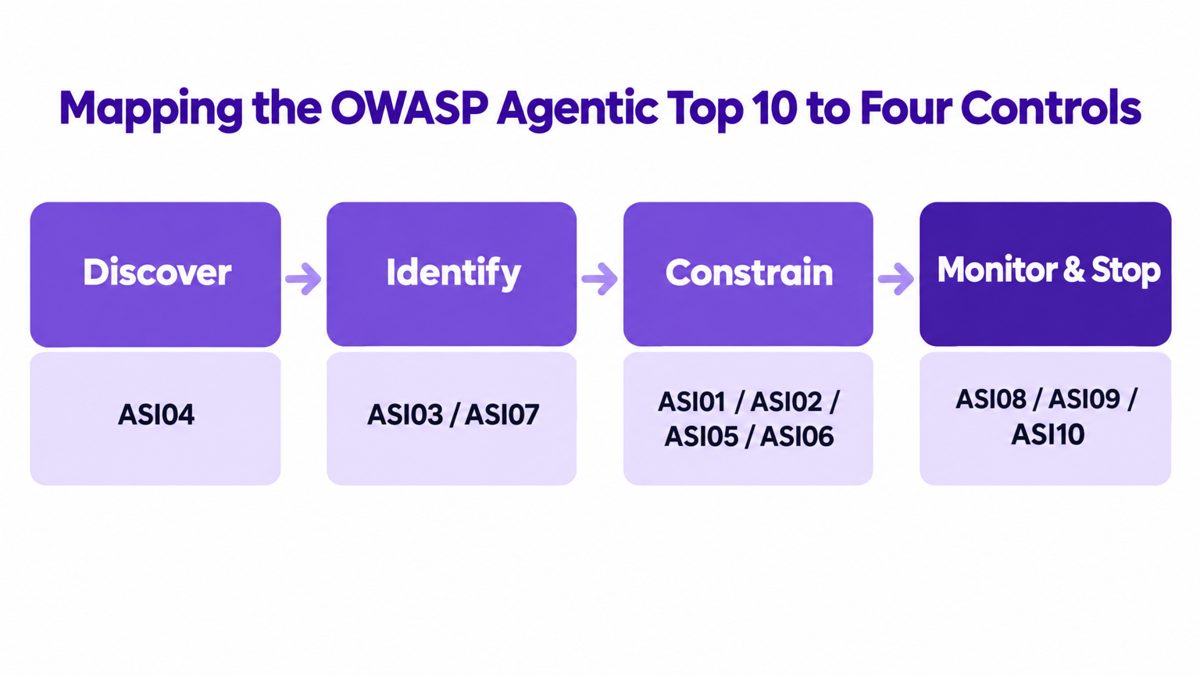
| Control | OWASP risks | Question it answers | Typical owner |
|---|---|---|---|
| Discover | ASI04 | Which agents, models, and tools are running? | CIO, IT operations |
| Identify | ASI03, ASI07 | Who owns each agent, and what can it access? | CISO, identity team |
| Constrain | ASI01, ASI02, ASI05, ASI06 | What is each agent allowed to do and read? | Security engineering, platform team |
| Monitor and stop | ASI08, ASI09, ASI10 | Is behavior and spend within baseline, and can we halt it? | SOC, FinOps lead |
Discover comes first for a reason. Every other control assumes an inventory, and agents built outside IT approval are the ones most likely to carry broad credentials, as CloudNuro's analysis of the shadow AI agent problem shows.
Monitor and stop is where security and finance meet. A cascading failure or a looping agent shows up first as an anomaly in token consumption, which is why TokenOps data belongs in the security team's view.
See how AgentNuro maps every agent to an owner, a budget, and a real-time policy.
Request a DemoAgentNuro is CloudNuro's Enterprise AI Adoption Management platform. It is a governance and cost layer that sits alongside the security tools that sandbox code or inspect prompts.
Discover: AgentNuro finds sanctioned and shadow AI across OpenAI, Claude, Gemini, Copilot, and more, with read-only connections, no agents, and no app changes.
Identify: AgentNuro maps every dollar and token to a user, project, model, agent, and business unit, so each agent has an accountable owner.
Monitor and stop: AgentNuro provides real-time control over model choice, data exposure, token consumption, and runaway spend, the financial side of ASI08 and ASI10.
It runs on the same foundation CloudNuro uses to govern SaaS and cloud spend, extended to agents through capabilities such as the AI Custodian. Teams new to the platform can follow how to get started with AgentNuro.
The OWASP Top 10 for Agentic Applications is a list of the ten most significant security risks in autonomous AI agents, labelled ASI01 through ASI10. It was released on December 9, 2025, and is titled for 2026.
The agentic list covers risks that appear when a model can act: calling tools, holding credentials, storing memory, and talking to other agents. The LLM list focuses mainly on the model's inputs and outputs.
CISOs should start with inventory, because supply chain (ASI04) and identity (ASI03) controls cannot cover agents nobody has found. Discovery of shadow agents is the first practical step.
The OWASP agentic standard is community guidance, not a regulation. Security teams use it as a reference for risk assessments, vendor questionnaires, and internal agent policies.
AI spend matters because cascading failures and drifting agents often surface first as abnormal token consumption. AgentNuro attributes token spend to each agent and applies real-time budget controls, giving security and finance one signal.
Written policies alone cannot satisfy it, because most listed mitigations act at runtime: scoped credentials, quotas, monitoring, and kill switches. CloudNuro explains this in its analysis of the agentic AI governance gap.
The OWASP 2026 agent security standards confirm that agents are actors, not applications. Organizations that govern them with documents alone will find their exposure through an incident or an invoice.
The better model gives every agent an inventory record, an owner, a scope, a budget, and a stop mechanism, with unified visibility across SaaS, cloud, and AI. Read alongside CloudNuro's guide to governing AI agents at enterprise scale, that is the operating model the standard points to.
Get a read-only assessment of the AI tools, agents, and spend across your enterprise.
Get Free Savings AssessmentAgentNuro gives CISOs, CIOs, and CFOs one governed view of every AI tool and agent in the enterprise. It discovers sanctioned and shadow AI without code changes, attributes every token to an owner, and applies real-time controls on models, budgets, and data exposure. Connect in minutes and see insights the next day.
CloudNuro is a leader in Enterprise AI Adoption Management, providing enterprises with unmatched visibility, governance, and cost optimization. Recognized twice in a row by Gartner in the SaaS Management Platforms and named a Leader in the Info-Tech SoftwareReviews Data Quadrant, CloudNuro is trusted by global enterprises and government agencies to bring financial discipline to SaaS, cloud, and AI. Trusted by enterprises, CloudNuro provides centralized SaaS inventory, license optimization, and renewal management along with advanced cost allocation and chargeback, giving IT and Finance leaders the visibility, control, and cost-conscious culture needed to drive financial discipline.
Request a no cost, no obligation free assessment —just 15 minutes to savings!
Get StartedThe OWASP Top 10 for Agentic Applications 2026 is the first widely adopted list of security risks specific to autonomous AI agents, released on December 9, 2025.
Its ten risks, from Agent Goal Hijack (ASI01) to Rogue Agents (ASI10), share one lesson: agents must be governed at runtime, with identity, scope, spend, and a stop mechanism attached to each one.
This post explains each risk in CISO terms, maps the ten to four governance controls, and gives a phased plan for putting the standard into practice.
Security frameworks were written for users and applications. AI agents are neither: they plan, call tools, hold credentials, and spend money without a person in each loop.
The OWASP 2026 agent security standards, formally the OWASP Top 10 for Agentic Applications, give CISOs a shared vocabulary for that gap. Most of its risks cannot be fixed by a written policy alone, because they happen at machine speed inside a running agent.
The pressure lands on three roles at once. CISOs own the risk, CIOs own the agent inventory, and CFOs own the token bill that a misbehaving agent can multiply overnight.
Many of these agents also start outside IT approval, which is why the standard begins where shadow AI detection begins: knowing what is running.
This guide explains the ten risks, groups them into four controls a security team can own, and shows how AgentNuro supports the governance layer the standard assumes.
See how AgentNuro finds sanctioned and shadow AI with read-only connections and no app changes.
Request a DemoThe OWASP Top 10 for Agentic Applications 2026 is a ranked list of the ten most significant security risks in autonomous AI systems, published by OWASP's GenAI Security Project on December 9, 2025. It extends earlier guidance on language model risks to agents that plan, use tools, keep memory, and act on their own.
The difference matters. A chatbot that gives a wrong answer is a quality problem; an agent that acts on a wrong instruction changes records, moves data, or runs up spend.
Untrusted content, such as a document or web page, redirects the agent's objective. The control is to treat every external input as data, never as instruction, and revalidate each plan step against the authorized goal.
An agent calls a legitimate tool with unsafe arguments. Least-privilege tool permissions, allowlists, and pre-execution policy checks limit the damage.
Agents inherit broad, long-lived credentials from the people who built them. Each agent needs its own identity with narrow, short-lived access, a point CloudNuro covers in its guide to AI agent access control and audit logs.
Compromised plugins, MCP servers, packages, or third-party agents enter the environment. A current inventory of every agent and its components is the precondition for vetting any of them.
Generated code runs beyond its intended boundary. Isolated, ephemeral sandboxes with no ambient credentials and strict resource limits contain it.
False or malicious data is stored and later trusted as context. Provenance labels, validated writes to memory and retrieval stores, and retention limits reduce exposure.
Messages between agents are spoofed, replayed, or altered. Mutual authentication, signed messages, and replay protection treat each agent as an identity that must prove itself.
One faulty decision propagates across agents and workflows. Action quotas, rate limits, circuit breakers, and anomaly monitoring stop the chain, and the same controls cap the token spend a loop can burn.
Automation bias or a misleading approval screen leads a person to authorize a harmful action. Approvals for irreversible actions must show the change, its scope, and its impact.
An agent drifts from its intended behavior or operates outside policy. Behavioral baselines, continuous monitoring, deny-by-default policy, credential revocation, and a kill switch are the listed mitigations. CloudNuro's AI agent monitoring playbook details how to set those baselines.
Ten risks are hard to staff. Grouped by the control that addresses them, they become four workstreams a CISO can assign an owner to.
| Control | OWASP risks | Question it answers | Typical owner |
|---|---|---|---|
| Discover | ASI04 | Which agents, models, and tools are running? | CIO, IT operations |
| Identify | ASI03, ASI07 | Who owns each agent, and what can it access? | CISO, identity team |
| Constrain | ASI01, ASI02, ASI05, ASI06 | What is each agent allowed to do and read? | Security engineering, platform team |
| Monitor and stop | ASI08, ASI09, ASI10 | Is behavior and spend within baseline, and can we halt it? | SOC, FinOps lead |
Discover comes first for a reason. Every other control assumes an inventory, and agents built outside IT approval are the ones most likely to carry broad credentials, as CloudNuro's analysis of the shadow AI agent problem shows.
Monitor and stop is where security and finance meet. A cascading failure or a looping agent shows up first as an anomaly in token consumption, which is why TokenOps data belongs in the security team's view.
See how AgentNuro maps every agent to an owner, a budget, and a real-time policy.
Request a DemoAgentNuro is CloudNuro's Enterprise AI Adoption Management platform. It is a governance and cost layer that sits alongside the security tools that sandbox code or inspect prompts.
Discover: AgentNuro finds sanctioned and shadow AI across OpenAI, Claude, Gemini, Copilot, and more, with read-only connections, no agents, and no app changes.
Identify: AgentNuro maps every dollar and token to a user, project, model, agent, and business unit, so each agent has an accountable owner.
Monitor and stop: AgentNuro provides real-time control over model choice, data exposure, token consumption, and runaway spend, the financial side of ASI08 and ASI10.
It runs on the same foundation CloudNuro uses to govern SaaS and cloud spend, extended to agents through capabilities such as the AI Custodian. Teams new to the platform can follow how to get started with AgentNuro.
The OWASP Top 10 for Agentic Applications is a list of the ten most significant security risks in autonomous AI agents, labelled ASI01 through ASI10. It was released on December 9, 2025, and is titled for 2026.
The agentic list covers risks that appear when a model can act: calling tools, holding credentials, storing memory, and talking to other agents. The LLM list focuses mainly on the model's inputs and outputs.
CISOs should start with inventory, because supply chain (ASI04) and identity (ASI03) controls cannot cover agents nobody has found. Discovery of shadow agents is the first practical step.
The OWASP agentic standard is community guidance, not a regulation. Security teams use it as a reference for risk assessments, vendor questionnaires, and internal agent policies.
AI spend matters because cascading failures and drifting agents often surface first as abnormal token consumption. AgentNuro attributes token spend to each agent and applies real-time budget controls, giving security and finance one signal.
Written policies alone cannot satisfy it, because most listed mitigations act at runtime: scoped credentials, quotas, monitoring, and kill switches. CloudNuro explains this in its analysis of the agentic AI governance gap.
The OWASP 2026 agent security standards confirm that agents are actors, not applications. Organizations that govern them with documents alone will find their exposure through an incident or an invoice.
The better model gives every agent an inventory record, an owner, a scope, a budget, and a stop mechanism, with unified visibility across SaaS, cloud, and AI. Read alongside CloudNuro's guide to governing AI agents at enterprise scale, that is the operating model the standard points to.
Get a read-only assessment of the AI tools, agents, and spend across your enterprise.
Get Free Savings AssessmentAgentNuro gives CISOs, CIOs, and CFOs one governed view of every AI tool and agent in the enterprise. It discovers sanctioned and shadow AI without code changes, attributes every token to an owner, and applies real-time controls on models, budgets, and data exposure. Connect in minutes and see insights the next day.
CloudNuro is a leader in Enterprise AI Adoption Management, providing enterprises with unmatched visibility, governance, and cost optimization. Recognized twice in a row by Gartner in the SaaS Management Platforms and named a Leader in the Info-Tech SoftwareReviews Data Quadrant, CloudNuro is trusted by global enterprises and government agencies to bring financial discipline to SaaS, cloud, and AI. Trusted by enterprises, CloudNuro provides centralized SaaS inventory, license optimization, and renewal management along with advanced cost allocation and chargeback, giving IT and Finance leaders the visibility, control, and cost-conscious culture needed to drive financial discipline.
Request a no cost, no obligation free assessment - just 15 minutes to savings!
Get StartedWe're offering complimentary ServiceNow license assessments to only 25 enterprises this quarter who want to unlock immediate savings without disrupting operations.
Get Free AssessmentGet Started




CloudNuro Corp
1755 Park St. Suite 207
Naperville, IL 60563
Phone : +1-630-277-9470
Email: info@cloudnuro.com






Recognized Leader in SaaS Management Platforms by Info-Tech SoftwareReviews