
Sign Up
Thank you for Submitting!
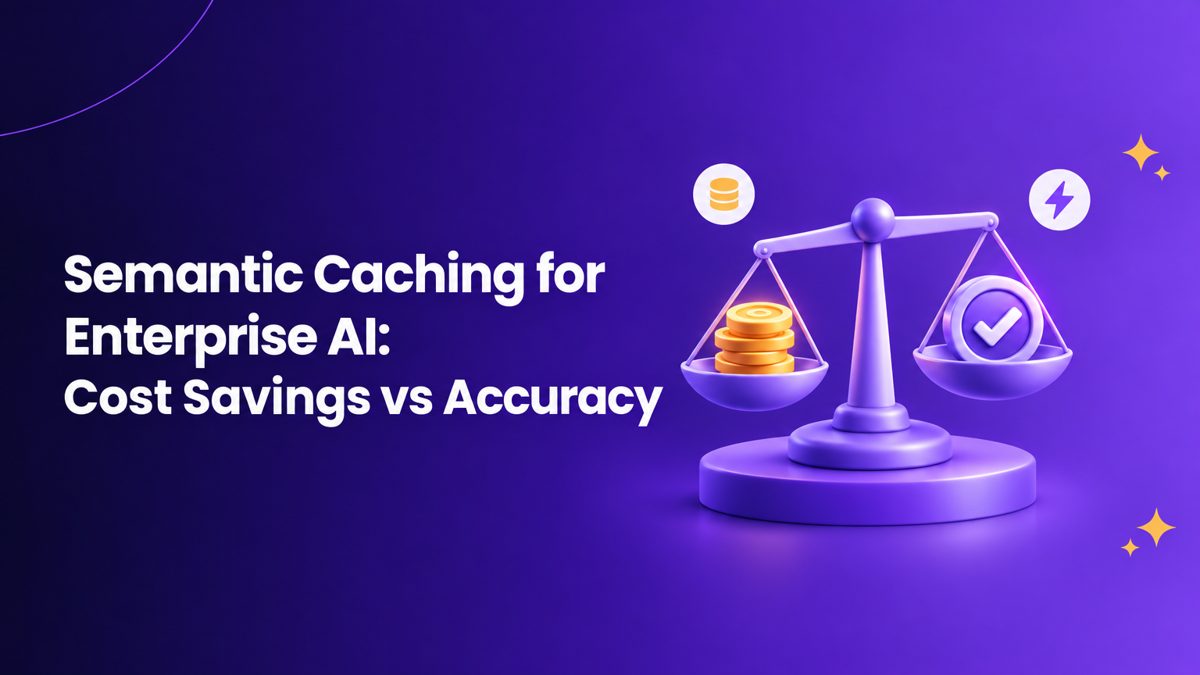
Semantic caching reuses a stored AI answer when a new prompt means the same thing as an earlier one, so the model is not called again.
In one benchmark of 63,796 real chatbot queries, loosening the similarity threshold from 0.99 to 0.75 raised the cache hit rate from 23.5% to 90.3% and the cost reduction from 15.8% to 86.3%.
This post explains when semantic caching for enterprise AI pays off, where it returns wrong answers, and how to govern it with cost and accuracy measured together.
Documented cost reductions from semantic caching range from roughly 40% to 86%, depending on the workload. That spread is the whole story: the same technique can halve an AI bill or barely move it.
AI spend is usage-based, so every repeated question that reaches a model is paid for again. As assistants and agents scale across HR, support, and internal knowledge, the volume of near-identical prompts grows with them.
CIOs want the latency gains, CFOs want the savings, and CISOs want proof that a cached answer never crosses a permission boundary. Those goals conflict at one setting: the similarity threshold.
Caching decisions belong inside the discipline of TokenOps for the token economy, where cost per token is weighed against value per token.
This guide explains how semantic caching works, when it reduces costs, when it hurts accuracy, and how AgentNuro helps enterprises measure both.
Get a no-cost assessment of how your AI spend maps to users, projects, models, and agents.
Get Free Savings AssessmentSemantic caching converts each prompt into an embedding, searches a vector store for a stored prompt with similar meaning, and returns the stored answer if the similarity score clears a threshold. An exact-match cache only fires on identical text; a semantic cache fires on paraphrases.
"How many vacation days do I get?" and "What is my annual leave allowance?" can share one cached answer. That reuse is where the savings and the risk both come from.
A cache hit is not free. Embedding generation, vector search, storage, invalidation, and misses still cost money, so a 50% hit rate does not mean a 50% lower bill.
The similarity threshold decides how close two prompts must be before the cache answers. The clearest public threshold curve shows how sharply the economics move with it.

Cost reduction by cosine similarity threshold across 63,796 chatbot queries.
| Threshold | Cache hit rate | Cached answer accuracy | Cost reduction | Latency reduction |
|---|---|---|---|---|
| 0.99 | 23.5% | 92.1% | 15.8% | 17.1% |
| 0.95 | 56.0% | 92.6% | 51.9% | 57.7% |
| 0.90 | 74.5% | 92.3% | 72.5% | 72.2% |
| 0.80 | 87.6% | 91.8% | 84.6% | 86.1% |
| 0.75 | 90.3% | 91.2% | 86.3% | 88.3% |
Measured accuracy fell by less than one percentage point across that range. Read alone, the table says to loosen the threshold as far as possible.
That reading is dangerous. Aggregate accuracy on a general chatbot workload hides the small class of near-matches where a reused answer is wrong, and in regulated workflows those are the errors that matter.
Semantic caching pays off when the same intent recurs often and the correct answer does not depend on who is asking or when.
Workloads with strong semantic repetition, such as FAQs and documentation queries, report hit rates of 60% to 85%. Answers are stable and shared by every user.
Support, HR, and legal knowledge bases with relatively stable corpora see more modest hit rates of 20% to 45%. Savings are real but smaller, so the cache's own running cost must be counted.
Cached responses have been measured at about 27 milliseconds against roughly 7 seconds for an uncached model call. Misses still pay full inference latency plus the lookup.
One reported deployment cut monthly API costs from $47,000 to $12,700, a 73% reduction, after raising its hit rate from 18% to 67%. Teams that track AI cost attribution by team and project can see which workloads have that repetition profile before building a cache.
A false positive happens when two prompts look alike to the embedding model but need different answers. These are the common failure patterns:
Practitioners warn that thresholds below roughly 0.88 to 0.90 increase false-positive matches, while thresholds above about 0.97 to 0.98 make the cache fire too rarely to matter.
The most serious enterprise risk is cross-tenant or cross-permission reuse. Similarity is not an access control, so cache keys must include tenant, authorization scope, model, system prompt version, retrieval index version, and locale.
A wrong cached answer also distorts unit economics. A cheap response that fails the task is waste, which is why enterprises should measure cost per successful AI task instead of cost per request.
AgentNuro, CloudNuro's Enterprise AI Adoption Management platform, gives leaders the evidence to decide where optimizations such as caching belong and whether they work.
Caching sits alongside model routing as a lever for lower cost per request. CloudNuro's explainer on when you need an AI model router covers the companion decision.
See how AgentNuro attributes every AI dollar and shows whether optimizations hold up on quality.
Request a DemoStart at 0.90 to 0.95 for ordinary FAQ and documentation traffic. Use exact matching or no semantic cache for fast-changing or high-consequence data.
Include tenant, role, model, prompt version, and index version in every key. A cached answer should never be served outside the scope that produced it.
Borderline similarity scores should trigger a fresh model call. The small cost is cheaper than a confident wrong answer.
Tie cache entries to the documents and policies behind them, with time-to-live limits. Freshness failures are accuracy failures.
Track hit rate, positive-hit accuracy, false-positive rate, p50 and p95 latency, and total cost including embeddings and storage. Report them by workload, alongside the AI agent and token spend visibility leaders already review.
Semantic caching is moving from a developer optimization to a governed control. As agents chain many model calls together, one cached error can propagate through a workflow, and real-time AI budget controls and caching policy will increasingly be set in the same place.
Enterprises that optimize for risk-adjusted cache reuse, rather than maximum hit rate, will keep both the savings and the trust of their users.
Semantic caching for enterprise AI stores model answers and reuses them when a new prompt has the same meaning as an earlier one. It compares prompt embeddings against a similarity threshold instead of requiring identical text.
Semantic caching has produced documented cost reductions of roughly 40% to 86%, depending on workload. Savings track the share of requests that can safely reuse an answer, minus the cost of embeddings, search, and storage.
A similarity threshold of 0.90 to 0.95 is a practical starting point for FAQ and documentation traffic. High-consequence or fast-changing data needs stricter thresholds, exact matching, or no semantic cache.
Semantic caching becomes a security risk when cache keys ignore tenant or permission scope, because a similar prompt can return an answer meant for someone else. Scoping keys to identity and context removes that path.
Exact-match caching only reuses an answer when the prompt text is identical, while semantic caching also matches paraphrases. Semantic caching hits far more often but introduces false-positive risk.
AgentNuro attributes AI spend to users, projects, models, agents, and business units, and tracks value per token alongside cost per token. The overview of what AgentNuro does covers its full scope.
Semantic caching for enterprise AI can remove a large share of repeated model spend, but the setting that maximizes savings is also the one that returns wrong answers.
Organizations that tune for hit rate alone trade a smaller bill for answers users stop trusting. The better model governs caching by risk class and measures cost and value together, inside one view of SaaS, cloud, and AI spend.
See how AgentNuro brings attribution, value per token, and runtime control into one platform.
Request a DemoAgentNuro, from CloudNuro, shows which AI workloads drive repeated spend, who owns them, and whether cheaper paths still deliver successful outcomes. It connects read-only, so teams can get started with AgentNuro without changing applications, and it sits on the same foundation CloudNuro uses to govern SaaS and cloud spend.
CloudNuro is a leader in Enterprise AI Adoption Management, providing enterprises with unmatched visibility, governance, and cost optimization. Recognized twice in a row by Gartner in the SaaS Management Platforms and named a Leader in the Info-Tech SoftwareReviews Data Quadrant, CloudNuro is trusted by global enterprises and government agencies to bring financial discipline to SaaS, cloud, and AI. Trusted by enterprises, CloudNuro provides centralized SaaS inventory, license optimization, and renewal management along with advanced cost allocation and chargeback, giving IT and Finance leaders the visibility, control, and cost-conscious culture needed to drive financial discipline.
Request a no cost, no obligation free assessment —just 15 minutes to savings!
Get StartedSemantic caching reuses a stored AI answer when a new prompt means the same thing as an earlier one, so the model is not called again.
In one benchmark of 63,796 real chatbot queries, loosening the similarity threshold from 0.99 to 0.75 raised the cache hit rate from 23.5% to 90.3% and the cost reduction from 15.8% to 86.3%.
This post explains when semantic caching for enterprise AI pays off, where it returns wrong answers, and how to govern it with cost and accuracy measured together.
Documented cost reductions from semantic caching range from roughly 40% to 86%, depending on the workload. That spread is the whole story: the same technique can halve an AI bill or barely move it.
AI spend is usage-based, so every repeated question that reaches a model is paid for again. As assistants and agents scale across HR, support, and internal knowledge, the volume of near-identical prompts grows with them.
CIOs want the latency gains, CFOs want the savings, and CISOs want proof that a cached answer never crosses a permission boundary. Those goals conflict at one setting: the similarity threshold.
Caching decisions belong inside the discipline of TokenOps for the token economy, where cost per token is weighed against value per token.
This guide explains how semantic caching works, when it reduces costs, when it hurts accuracy, and how AgentNuro helps enterprises measure both.
Get a no-cost assessment of how your AI spend maps to users, projects, models, and agents.
Get Free Savings AssessmentSemantic caching converts each prompt into an embedding, searches a vector store for a stored prompt with similar meaning, and returns the stored answer if the similarity score clears a threshold. An exact-match cache only fires on identical text; a semantic cache fires on paraphrases.
"How many vacation days do I get?" and "What is my annual leave allowance?" can share one cached answer. That reuse is where the savings and the risk both come from.
A cache hit is not free. Embedding generation, vector search, storage, invalidation, and misses still cost money, so a 50% hit rate does not mean a 50% lower bill.
The similarity threshold decides how close two prompts must be before the cache answers. The clearest public threshold curve shows how sharply the economics move with it.
Cost reduction by cosine similarity threshold across 63,796 chatbot queries.
| Threshold | Cache hit rate | Cached answer accuracy | Cost reduction | Latency reduction |
|---|---|---|---|---|
| 0.99 | 23.5% | 92.1% | 15.8% | 17.1% |
| 0.95 | 56.0% | 92.6% | 51.9% | 57.7% |
| 0.90 | 74.5% | 92.3% | 72.5% | 72.2% |
| 0.80 | 87.6% | 91.8% | 84.6% | 86.1% |
| 0.75 | 90.3% | 91.2% | 86.3% | 88.3% |
Measured accuracy fell by less than one percentage point across that range. Read alone, the table says to loosen the threshold as far as possible.
That reading is dangerous. Aggregate accuracy on a general chatbot workload hides the small class of near-matches where a reused answer is wrong, and in regulated workflows those are the errors that matter.
Semantic caching pays off when the same intent recurs often and the correct answer does not depend on who is asking or when.
Workloads with strong semantic repetition, such as FAQs and documentation queries, report hit rates of 60% to 85%. Answers are stable and shared by every user.
Support, HR, and legal knowledge bases with relatively stable corpora see more modest hit rates of 20% to 45%. Savings are real but smaller, so the cache's own running cost must be counted.
Cached responses have been measured at about 27 milliseconds against roughly 7 seconds for an uncached model call. Misses still pay full inference latency plus the lookup.
One reported deployment cut monthly API costs from $47,000 to $12,700, a 73% reduction, after raising its hit rate from 18% to 67%. Teams that track AI cost attribution by team and project can see which workloads have that repetition profile before building a cache.
A false positive happens when two prompts look alike to the embedding model but need different answers. These are the common failure patterns:
Practitioners warn that thresholds below roughly 0.88 to 0.90 increase false-positive matches, while thresholds above about 0.97 to 0.98 make the cache fire too rarely to matter.
The most serious enterprise risk is cross-tenant or cross-permission reuse. Similarity is not an access control, so cache keys must include tenant, authorization scope, model, system prompt version, retrieval index version, and locale.
A wrong cached answer also distorts unit economics. A cheap response that fails the task is waste, which is why enterprises should measure cost per successful AI task instead of cost per request.
AgentNuro, CloudNuro's Enterprise AI Adoption Management platform, gives leaders the evidence to decide where optimizations such as caching belong and whether they work.
Caching sits alongside model routing as a lever for lower cost per request. CloudNuro's explainer on when you need an AI model router covers the companion decision.
See how AgentNuro attributes every AI dollar and shows whether optimizations hold up on quality.
Request a DemoStart at 0.90 to 0.95 for ordinary FAQ and documentation traffic. Use exact matching or no semantic cache for fast-changing or high-consequence data.
Include tenant, role, model, prompt version, and index version in every key. A cached answer should never be served outside the scope that produced it.
Borderline similarity scores should trigger a fresh model call. The small cost is cheaper than a confident wrong answer.
Tie cache entries to the documents and policies behind them, with time-to-live limits. Freshness failures are accuracy failures.
Track hit rate, positive-hit accuracy, false-positive rate, p50 and p95 latency, and total cost including embeddings and storage. Report them by workload, alongside the AI agent and token spend visibility leaders already review.
Semantic caching is moving from a developer optimization to a governed control. As agents chain many model calls together, one cached error can propagate through a workflow, and real-time AI budget controls and caching policy will increasingly be set in the same place.
Enterprises that optimize for risk-adjusted cache reuse, rather than maximum hit rate, will keep both the savings and the trust of their users.
Semantic caching for enterprise AI stores model answers and reuses them when a new prompt has the same meaning as an earlier one. It compares prompt embeddings against a similarity threshold instead of requiring identical text.
Semantic caching has produced documented cost reductions of roughly 40% to 86%, depending on workload. Savings track the share of requests that can safely reuse an answer, minus the cost of embeddings, search, and storage.
A similarity threshold of 0.90 to 0.95 is a practical starting point for FAQ and documentation traffic. High-consequence or fast-changing data needs stricter thresholds, exact matching, or no semantic cache.
Semantic caching becomes a security risk when cache keys ignore tenant or permission scope, because a similar prompt can return an answer meant for someone else. Scoping keys to identity and context removes that path.
Exact-match caching only reuses an answer when the prompt text is identical, while semantic caching also matches paraphrases. Semantic caching hits far more often but introduces false-positive risk.
AgentNuro attributes AI spend to users, projects, models, agents, and business units, and tracks value per token alongside cost per token. The overview of what AgentNuro does covers its full scope.
Semantic caching for enterprise AI can remove a large share of repeated model spend, but the setting that maximizes savings is also the one that returns wrong answers.
Organizations that tune for hit rate alone trade a smaller bill for answers users stop trusting. The better model governs caching by risk class and measures cost and value together, inside one view of SaaS, cloud, and AI spend.
See how AgentNuro brings attribution, value per token, and runtime control into one platform.
Request a DemoAgentNuro, from CloudNuro, shows which AI workloads drive repeated spend, who owns them, and whether cheaper paths still deliver successful outcomes. It connects read-only, so teams can get started with AgentNuro without changing applications, and it sits on the same foundation CloudNuro uses to govern SaaS and cloud spend.
CloudNuro is a leader in Enterprise AI Adoption Management, providing enterprises with unmatched visibility, governance, and cost optimization. Recognized twice in a row by Gartner in the SaaS Management Platforms and named a Leader in the Info-Tech SoftwareReviews Data Quadrant, CloudNuro is trusted by global enterprises and government agencies to bring financial discipline to SaaS, cloud, and AI. Trusted by enterprises, CloudNuro provides centralized SaaS inventory, license optimization, and renewal management along with advanced cost allocation and chargeback, giving IT and Finance leaders the visibility, control, and cost-conscious culture needed to drive financial discipline.
Request a no cost, no obligation free assessment - just 15 minutes to savings!
Get StartedWe're offering complimentary ServiceNow license assessments to only 25 enterprises this quarter who want to unlock immediate savings without disrupting operations.
Get Free AssessmentGet Started




CloudNuro Corp
1755 Park St. Suite 207
Naperville, IL 60563
Phone : +1-630-277-9470
Email: info@cloudnuro.com







Recognized Leader in SaaS Management Platforms by Info-Tech SoftwareReviews