
Sign Up
Thank you for Submitting!
The price of GPT-3.5-level model performance fell roughly 280x, from about $20 to $0.07 per million tokens, yet enterprise AI bills keep climbing. Cost per token is falling, and cost per successful AI task is the metric that shows why the bill still rises.
AI agents changed the arithmetic. Agentic workloads consume 5x to 30x more tokens per task than a standard chatbot exchange, and they make 3x to 10x more model calls to finish the same request.
CIOs, CFOs, and AI leaders feel this first. The CFO sees a token rate that looks cheap and an invoice that does not. The CIO cannot say which agents earn their keep.
The answer is a unit metric tied to outcomes, which is the next step in the TokenOps practice for the token economy.
This post explains why cost per token misleads, how to calculate cost per successful AI task, and how AgentNuro gives AI spend the denominator it needs.
See how AgentNuro maps every AI dollar and token to a user, project, model, and agent.
Request a DemoCost per token is a pricing metric: it tells you what a provider charges for input and output. It says nothing about how many tokens a task consumes, how many attempts it takes, or whether the result was usable.
In agentic workflows, generated output is often only 5% to 15% of the tokens consumed. The rest is repeated context: system prompts, conversation history, retrieved documents, and tool results sent back to the model on every step.
That is why a lower rate card rarely shows up as a lower bill. Teams compare per seat, per token, and per outcome pricing models, but the unit that matters to the business is the completed task.
Roughly 60% of an agentic task's cost goes to retries, re-prompts, and validation loops. That spend is invisible in a cost-per-token view, because every retry is billed at the same low rate.
An agent that checks its own work and tries again pays for every attempt. A loop without a stop condition keeps billing until someone notices.
Each tool call adds results to the context window, and the next model call resends all of it. A ten-step task can cost far more than ten times a single step.
Leading agents still fail about one in three attempts on structured benchmark tasks. A failed run consumes the same tokens as a successful one and produces nothing the business can use.
These drivers only become manageable when each one is attributed. CloudNuro's guide to tagging and attributing every token covers the allocation groundwork.
Cost per successful AI task is total task spend divided by the number of tasks that pass an acceptance check. Total task spend includes token spend, retries, and tool calls, not only the final model response.
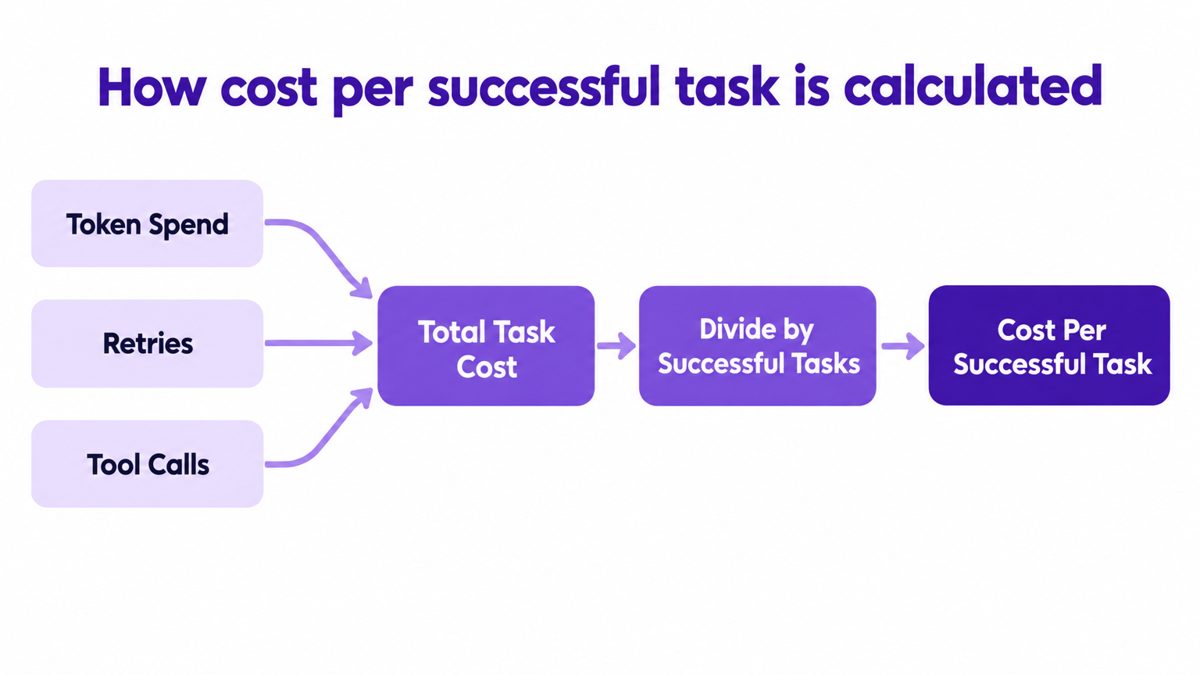
Cost per successful task = (token spend + retry spend + tool call spend) ÷ tasks that pass acceptance
The figures below are illustrative. They show how the cheaper agent per run can be the more expensive agent per outcome.
| Metric | Agent A (larger model) | Agent B (smaller model) |
|---|---|---|
| Average cost per run | $0.40 | $0.25 |
| Runs per month | 10,000 | 10,000 |
| Success rate | 90% | 50% |
| Monthly spend | $4,000 | $2,500 |
| Successful tasks | 9,000 | 5,000 |
| Cost per successful task | $0.44 | $0.50 |
Agent B looks 37.5% cheaper per run and is about 14% more expensive per outcome. The 4,000 failed tasks also carry a hidden cost: human rework, which the token bill never shows.
Success must be defined per task type before measurement starts: a ticket resolved without escalation, a document summary accepted without edits, a code change that passes tests. Without that definition, the metric becomes cost per attempt again.
The same unit logic applies to product features, as covered in CloudNuro's work on AI unit economics and cost per customer.
Get an assessment of idle agents, oversized models, and low-value AI spend across your estate.
Get Free Savings AssessmentAgentNuro, CloudNuro's Enterprise AI Adoption Management platform, is built around one question: cost per token, or value per token. It gives AI spend a denominator for ROI.
AgentNuro maps every AI dollar and token to a user, project, model, agent, and business unit, across sanctioned and shadow AI on OpenAI, Claude, Gemini, Copilot, and more. CloudNuro explains the method in how AgentNuro attributes every dollar to teams and projects.
CloudNuro breaks down AI spend across projects, agents, and models to identify idle or low-value agents, duplicate implementations, overpowered models used for simple tasks, and inefficient prompt or context usage.
Teams set budget limits at the project and individual agent level, and AgentNuro provides real-time control over model choice, data exposure, token consumption, and runaway spend. See how teams set and enforce LLM spending limits per team.
Discovery is read-only and changes nothing in your applications. Teams connect in minutes and see insights the next day, as described in how AgentNuro gives visibility into AI agents and token spend.
Agree with each business owner what a successful outcome is, and record it before you compare agents or models.
A cost you cannot assign to an owner cannot be divided by an outcome. Attribution comes first.
Report retry spend as its own line. When it grows faster than successful tasks, the agent needs a stop condition or a redesign.
Route simple tasks to smaller models only when their cost per successful task is lower, as the worked example shows.
Budget from expected successful tasks multiplied by cost per successful task. CloudNuro's guide to budgeting for tokens, calls, and credits covers the forecasting model.
As agents take on more work, the token will become an input cost, like compute hours in cloud FinOps. Finance will budget AI the way it budgets any operating function: by outcomes delivered.
Enterprises that build an AI token management office now will have the baseline data to make that shift.
Cost per successful AI task is the total spend on an AI workflow, including tokens, retries, and tool calls, divided by the number of tasks that meet an agreed acceptance check. It measures what a usable outcome costs, not what a provider charges per token.
Cost per token is misleading for AI agents because agents consume 5x to 30x more tokens per task than a chatbot exchange. Token rates fall while total task cost rises.
Retries can account for roughly 60% of an agentic task's cost, through re-prompts and validation loops. Each attempt is billed in full, whether or not the final result is usable.
A successful AI task is one that meets an acceptance check set by its business owner, such as a ticket closed without escalation. Define it per task type before you start measuring.
A cheaper model is not always more cost-effective, because a lower success rate can raise the cost per successful task. Compare models on outcomes delivered, not on rate cards. Pricing structure also matters, as explained in CloudNuro's overview of consumption pricing with credits, tokens, and metering.
AgentNuro maps every AI dollar and token to a user, project, model, agent, and business unit, which gives AI spend a denominator for ROI. It also flags idle agents, duplicate implementations, and oversized models.
Token prices have collapsed, but agents have multiplied the tokens, calls, and retries behind every task. Enterprises that track only cost per token will keep approving cheap rates and paying for expensive outcomes. Cost per successful AI task connects AI spend to business value, and it depends on unified visibility and accountability across SaaS, cloud, and AI.
See how AgentNuro connects every AI agent's spend to the work it delivers.
Request a DemoAgentNuro, built on CloudNuro's SaaS and cloud FinOps foundation, discovers sanctioned and shadow AI, attributes every token to an owner, and applies real-time budget and model controls. With the AI Custodian, IT and Finance get one source of truth for what AI costs and what it delivers.
CloudNuro is a leader in Enterprise AI Adoption Management, providing enterprises with unmatched visibility, governance, and cost optimization. Recognized twice in a row by Gartner in the SaaS Management Platforms and named a Leader in the Info-Tech SoftwareReviews Data Quadrant, CloudNuro is trusted by global enterprises and government agencies to bring financial discipline to SaaS, cloud, and AI. Trusted by enterprises, CloudNuro provides centralized SaaS inventory, license optimization, and renewal management along with advanced cost allocation and chargeback, giving IT and Finance leaders the visibility, control, and cost-conscious culture needed to drive financial discipline.
Request a no cost, no obligation free assessment —just 15 minutes to savings!
Get StartedThe price of GPT-3.5-level model performance fell roughly 280x, from about $20 to $0.07 per million tokens, yet enterprise AI bills keep climbing. Cost per token is falling, and cost per successful AI task is the metric that shows why the bill still rises.
AI agents changed the arithmetic. Agentic workloads consume 5x to 30x more tokens per task than a standard chatbot exchange, and they make 3x to 10x more model calls to finish the same request.
CIOs, CFOs, and AI leaders feel this first. The CFO sees a token rate that looks cheap and an invoice that does not. The CIO cannot say which agents earn their keep.
The answer is a unit metric tied to outcomes, which is the next step in the TokenOps practice for the token economy.
This post explains why cost per token misleads, how to calculate cost per successful AI task, and how AgentNuro gives AI spend the denominator it needs.
See how AgentNuro maps every AI dollar and token to a user, project, model, and agent.
Request a DemoCost per token is a pricing metric: it tells you what a provider charges for input and output. It says nothing about how many tokens a task consumes, how many attempts it takes, or whether the result was usable.
In agentic workflows, generated output is often only 5% to 15% of the tokens consumed. The rest is repeated context: system prompts, conversation history, retrieved documents, and tool results sent back to the model on every step.
That is why a lower rate card rarely shows up as a lower bill. Teams compare per seat, per token, and per outcome pricing models, but the unit that matters to the business is the completed task.
Roughly 60% of an agentic task's cost goes to retries, re-prompts, and validation loops. That spend is invisible in a cost-per-token view, because every retry is billed at the same low rate.
An agent that checks its own work and tries again pays for every attempt. A loop without a stop condition keeps billing until someone notices.
Each tool call adds results to the context window, and the next model call resends all of it. A ten-step task can cost far more than ten times a single step.
Leading agents still fail about one in three attempts on structured benchmark tasks. A failed run consumes the same tokens as a successful one and produces nothing the business can use.
These drivers only become manageable when each one is attributed. CloudNuro's guide to tagging and attributing every token covers the allocation groundwork.
Cost per successful AI task is total task spend divided by the number of tasks that pass an acceptance check. Total task spend includes token spend, retries, and tool calls, not only the final model response.
Cost per successful task = (token spend + retry spend + tool call spend) ÷ tasks that pass acceptance
The figures below are illustrative. They show how the cheaper agent per run can be the more expensive agent per outcome.
| Metric | Agent A (larger model) | Agent B (smaller model) |
|---|---|---|
| Average cost per run | $0.40 | $0.25 |
| Runs per month | 10,000 | 10,000 |
| Success rate | 90% | 50% |
| Monthly spend | $4,000 | $2,500 |
| Successful tasks | 9,000 | 5,000 |
| Cost per successful task | $0.44 | $0.50 |
Agent B looks 37.5% cheaper per run and is about 14% more expensive per outcome. The 4,000 failed tasks also carry a hidden cost: human rework, which the token bill never shows.
Success must be defined per task type before measurement starts: a ticket resolved without escalation, a document summary accepted without edits, a code change that passes tests. Without that definition, the metric becomes cost per attempt again.
The same unit logic applies to product features, as covered in CloudNuro's work on AI unit economics and cost per customer.
Get an assessment of idle agents, oversized models, and low-value AI spend across your estate.
Get Free Savings AssessmentAgentNuro, CloudNuro's Enterprise AI Adoption Management platform, is built around one question: cost per token, or value per token. It gives AI spend a denominator for ROI.
AgentNuro maps every AI dollar and token to a user, project, model, agent, and business unit, across sanctioned and shadow AI on OpenAI, Claude, Gemini, Copilot, and more. CloudNuro explains the method in how AgentNuro attributes every dollar to teams and projects.
CloudNuro breaks down AI spend across projects, agents, and models to identify idle or low-value agents, duplicate implementations, overpowered models used for simple tasks, and inefficient prompt or context usage.
Teams set budget limits at the project and individual agent level, and AgentNuro provides real-time control over model choice, data exposure, token consumption, and runaway spend. See how teams set and enforce LLM spending limits per team.
Discovery is read-only and changes nothing in your applications. Teams connect in minutes and see insights the next day, as described in how AgentNuro gives visibility into AI agents and token spend.
Agree with each business owner what a successful outcome is, and record it before you compare agents or models.
A cost you cannot assign to an owner cannot be divided by an outcome. Attribution comes first.
Report retry spend as its own line. When it grows faster than successful tasks, the agent needs a stop condition or a redesign.
Route simple tasks to smaller models only when their cost per successful task is lower, as the worked example shows.
Budget from expected successful tasks multiplied by cost per successful task. CloudNuro's guide to budgeting for tokens, calls, and credits covers the forecasting model.
As agents take on more work, the token will become an input cost, like compute hours in cloud FinOps. Finance will budget AI the way it budgets any operating function: by outcomes delivered.
Enterprises that build an AI token management office now will have the baseline data to make that shift.
Cost per successful AI task is the total spend on an AI workflow, including tokens, retries, and tool calls, divided by the number of tasks that meet an agreed acceptance check. It measures what a usable outcome costs, not what a provider charges per token.
Cost per token is misleading for AI agents because agents consume 5x to 30x more tokens per task than a chatbot exchange. Token rates fall while total task cost rises.
Retries can account for roughly 60% of an agentic task's cost, through re-prompts and validation loops. Each attempt is billed in full, whether or not the final result is usable.
A successful AI task is one that meets an acceptance check set by its business owner, such as a ticket closed without escalation. Define it per task type before you start measuring.
A cheaper model is not always more cost-effective, because a lower success rate can raise the cost per successful task. Compare models on outcomes delivered, not on rate cards. Pricing structure also matters, as explained in CloudNuro's overview of consumption pricing with credits, tokens, and metering.
AgentNuro maps every AI dollar and token to a user, project, model, agent, and business unit, which gives AI spend a denominator for ROI. It also flags idle agents, duplicate implementations, and oversized models.
Token prices have collapsed, but agents have multiplied the tokens, calls, and retries behind every task. Enterprises that track only cost per token will keep approving cheap rates and paying for expensive outcomes. Cost per successful AI task connects AI spend to business value, and it depends on unified visibility and accountability across SaaS, cloud, and AI.
See how AgentNuro connects every AI agent's spend to the work it delivers.
Request a DemoAgentNuro, built on CloudNuro's SaaS and cloud FinOps foundation, discovers sanctioned and shadow AI, attributes every token to an owner, and applies real-time budget and model controls. With the AI Custodian, IT and Finance get one source of truth for what AI costs and what it delivers.
CloudNuro is a leader in Enterprise AI Adoption Management, providing enterprises with unmatched visibility, governance, and cost optimization. Recognized twice in a row by Gartner in the SaaS Management Platforms and named a Leader in the Info-Tech SoftwareReviews Data Quadrant, CloudNuro is trusted by global enterprises and government agencies to bring financial discipline to SaaS, cloud, and AI. Trusted by enterprises, CloudNuro provides centralized SaaS inventory, license optimization, and renewal management along with advanced cost allocation and chargeback, giving IT and Finance leaders the visibility, control, and cost-conscious culture needed to drive financial discipline.
Request a no cost, no obligation free assessment - just 15 minutes to savings!
Get StartedWe're offering complimentary ServiceNow license assessments to only 25 enterprises this quarter who want to unlock immediate savings without disrupting operations.
Get Free AssessmentGet Started




CloudNuro Corp
1755 Park St. Suite 207
Naperville, IL 60563
Phone : +1-630-277-9470
Email: info@cloudnuro.com







Recognized Leader in SaaS Management Platforms by Info-Tech SoftwareReviews