
Sign Up
Thank you for Submitting!
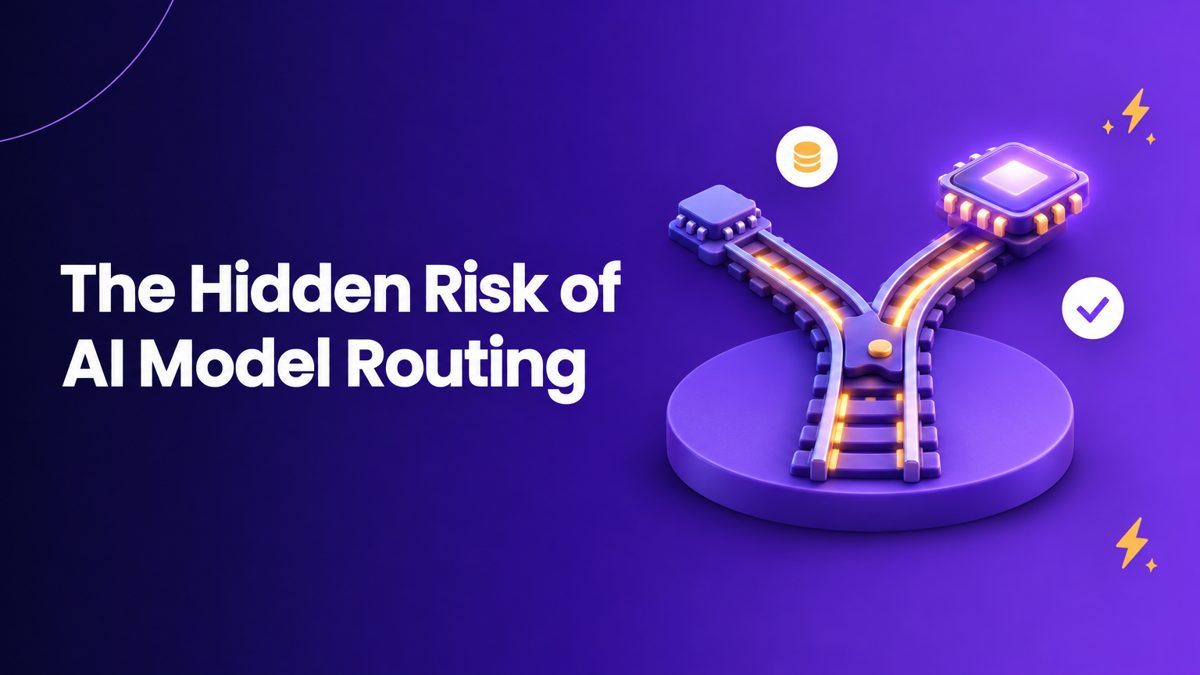
AI model routing sends each request to the cheapest model that can handle it, and on favorable workloads it has cut inference cost by more than 85%.
The hidden risk is that routing errors do not crash anything: a cheaper model returns a plausible but weaker answer, and nobody sees the quality loss on the invoice.
This post explains where routing savings come from, where quality breaks, and how to govern routing with cost per successful task instead of cost per token.
On one widely cited benchmark, a trained AI model routing layer cut cost by more than 85% while keeping about 95% of frontier-model quality. On harder math reasoning, the same approach saved only about 35%.
That gap is the whole story. Routing savings depend on the work being routed, and the requests where cheap models fail are often the ones the business cares about most.
Engineering usually picks the model. IT finds out after the fact. Finance pays the bill. CIOs, CFOs, and AI leaders now share a question no single team can answer alone: is the cheaper model still doing the job?
Routing has moved from a developer optimization to a financial and quality control that belongs inside TokenOps, the FinOps practice for the token economy.
This post explains how routing works, the five quality risks it hides, and a governance model that keeps savings without trading away enterprise-grade answers.
AgentNuro maps every AI dollar and token to a user, project, model, and agent.
Request a DemoAI model routing is a layer that classifies each request and sends it to a lower-cost model or a frontier model based on predicted difficulty. Routine work such as classification, extraction, formatting, and short summaries goes to the cheaper model; ambiguous or reasoning-heavy work escalates.
The saving comes from the share of traffic that leaves the expensive model, not from the router itself. In the most aggressive benchmark configuration, only about 14% of requests reached the strong model.
Production results are smaller but still material. One 2026 enterprise pilot reported a 58% reduction in inference cost with 91% response acceptance.

The routing table below shows how savings shrink as reasoning load grows.
| Workload | Reported cost reduction | Quality sensitivity |
|---|---|---|
| Conversational benchmark | More than 85% | Low (about 95% of frontier quality kept) |
| Enterprise production pilot | 58% | Moderate (91% response acceptance) |
| Broad knowledge questions | About 45% | Higher |
| Multi-step math reasoning | About 35% | Highest |
Routing failures rarely raise an error. They produce answers that look complete and are less accurate, less grounded, or less useful, which is why AI calls can fail while every dashboard says fine.
A misrouted request returns a plausible answer, so latency, uptime, and spend all look healthy. The cost appears later as rework, escalations, and lost trust in the AI program.
A router tuned on conversational tests can underperform on legal, financial, clinical, or coding work. The same router that saved more than 85% on chat saved about 35% on multi-step reasoning, which shows quality is task-specific.
An average near 95% can hide a small set of high-value requests that degrade badly. A 1% error rate on routine summaries is a different business risk from a 1% error rate on compliance decisions.
Routers learn from historical traffic. New models, new prompts, new user groups, and new agent workflows change that traffic, and routing thresholds that worked last quarter drift without anyone noticing.
When a cheap model fails inside an agent, the agent often retries or escalates, paying for both models. As explained in CloudNuro's guide to measuring cost per successful AI task, a lower token price can still mean a higher cost per finished outcome.
Get a no-cost assessment of your AI model mix, token spend, and wasted retries.
Get Free Savings AssessmentAgentNuro, CloudNuro's Enterprise AI Adoption Management platform, gives IT, Finance, and AI leaders one view of which models run, who uses them, and what they cost. It connects read-only in minutes, with no agents installed and no application changes.
Because AgentNuro is built on CloudNuro's SaaS and cloud FinOps foundation, AI spend sits in the same control plane as the rest of the technology estate, alongside capabilities such as CloudNuro AI Custodian.
Start with low-risk, high-volume categories. Force compliance, financial, and customer-escalation intents to the frontier model regardless of predicted difficulty.
Before any routing change ships, compare it with the frontier-only result on a labeled set of representative requests per category. Block the change if any high-risk category falls below its threshold.
Measure accepted outcomes, rework, escalation rate, and retries per task. Pair this with AI cost allocation that tags every token so each route has an owner.
Re-run evaluations whenever a model, prompt, or agent workflow changes. The AI agent monitoring playbook covers the telemetry to watch.
Routing works best alongside caching and prompt discipline. Compare options in CloudNuro's guides to semantic, prompt, and KV caching and token-reduction prompt patterns.
As agents chain dozens of model calls per task, routing decisions will multiply inside every workflow. Enterprises will treat routing policy like any other financial control: owned, audited, and measured against outcomes.
AI model routing is the practice of sending each AI request to the most cost-effective model able to handle it. Simple requests go to cheaper models, and complex or high-risk requests escalate to frontier models.
AI model routing savings range from about 35% on reasoning-heavy work to more than 85% on favorable conversational benchmarks. One enterprise production pilot reported a 58% reduction.
Cheaper AI models can maintain enterprise-grade quality on routine, well-defined tasks. They need guardrails on reasoning-heavy, regulated, or customer-facing requests, where quality loss costs more than the token saving.
Quality loss from routing is hard to detect because misrouted requests still return plausible answers. Only outcome metrics such as acceptance, rework, and escalation rates reveal it.
Enterprises should judge routing by cost per successful task, not cost per token. AgentNuro attributes token spend to each model, agent, and project so that metric has a reliable cost side.
Routing policies only govern traffic you can see, so unapproved models and agents bypass them. Read more in CloudNuro's analysis of the shadow AI agent problem.
AI model routing has turned model choice into a recurring financial decision made thousands of times a day. Organizations that measure only token price will bank visible savings while quality erodes out of view. The better model gives every route an owner, a quality threshold, and a cost per successful task, inside one governed view of SaaS, cloud, and AI.
See how AgentNuro brings real-time control to model choice, token spend, and AI budgets.
Request a DemoAgentNuro gives CIOs, CFOs, and AI leaders a single view of which models run, who uses them, and what each costs. With every token attributed and real-time controls over model choice and runaway spend, teams can route to cheaper models where quality holds and escalate where it does not.
CloudNuro is a leader in Enterprise AI Adoption Management, providing enterprises with unmatched visibility, governance, and cost optimization. Recognized twice in a row by Gartner in the SaaS Management Platforms and named a Leader in the Info-Tech SoftwareReviews Data Quadrant, CloudNuro is trusted by global enterprises and government agencies to bring financial discipline to SaaS, cloud, and AI. Trusted by enterprises, CloudNuro provides centralized SaaS inventory, license optimization, and renewal management along with advanced cost allocation and chargeback, giving IT and Finance leaders the visibility, control, and cost-conscious culture needed to drive financial discipline.
Request a no cost, no obligation free assessment —just 15 minutes to savings!
Get StartedAI model routing sends each request to the cheapest model that can handle it, and on favorable workloads it has cut inference cost by more than 85%.
The hidden risk is that routing errors do not crash anything: a cheaper model returns a plausible but weaker answer, and nobody sees the quality loss on the invoice.
This post explains where routing savings come from, where quality breaks, and how to govern routing with cost per successful task instead of cost per token.
On one widely cited benchmark, a trained AI model routing layer cut cost by more than 85% while keeping about 95% of frontier-model quality. On harder math reasoning, the same approach saved only about 35%.
That gap is the whole story. Routing savings depend on the work being routed, and the requests where cheap models fail are often the ones the business cares about most.
Engineering usually picks the model. IT finds out after the fact. Finance pays the bill. CIOs, CFOs, and AI leaders now share a question no single team can answer alone: is the cheaper model still doing the job?
Routing has moved from a developer optimization to a financial and quality control that belongs inside TokenOps, the FinOps practice for the token economy.
This post explains how routing works, the five quality risks it hides, and a governance model that keeps savings without trading away enterprise-grade answers.
AgentNuro maps every AI dollar and token to a user, project, model, and agent.
Request a DemoAI model routing is a layer that classifies each request and sends it to a lower-cost model or a frontier model based on predicted difficulty. Routine work such as classification, extraction, formatting, and short summaries goes to the cheaper model; ambiguous or reasoning-heavy work escalates.
The saving comes from the share of traffic that leaves the expensive model, not from the router itself. In the most aggressive benchmark configuration, only about 14% of requests reached the strong model.
Production results are smaller but still material. One 2026 enterprise pilot reported a 58% reduction in inference cost with 91% response acceptance.
The routing table below shows how savings shrink as reasoning load grows.
| Workload | Reported cost reduction | Quality sensitivity |
|---|---|---|
| Conversational benchmark | More than 85% | Low (about 95% of frontier quality kept) |
| Enterprise production pilot | 58% | Moderate (91% response acceptance) |
| Broad knowledge questions | About 45% | Higher |
| Multi-step math reasoning | About 35% | Highest |
Routing failures rarely raise an error. They produce answers that look complete and are less accurate, less grounded, or less useful, which is why AI calls can fail while every dashboard says fine.
A misrouted request returns a plausible answer, so latency, uptime, and spend all look healthy. The cost appears later as rework, escalations, and lost trust in the AI program.
A router tuned on conversational tests can underperform on legal, financial, clinical, or coding work. The same router that saved more than 85% on chat saved about 35% on multi-step reasoning, which shows quality is task-specific.
An average near 95% can hide a small set of high-value requests that degrade badly. A 1% error rate on routine summaries is a different business risk from a 1% error rate on compliance decisions.
Routers learn from historical traffic. New models, new prompts, new user groups, and new agent workflows change that traffic, and routing thresholds that worked last quarter drift without anyone noticing.
When a cheap model fails inside an agent, the agent often retries or escalates, paying for both models. As explained in CloudNuro's guide to measuring cost per successful AI task, a lower token price can still mean a higher cost per finished outcome.
Get a no-cost assessment of your AI model mix, token spend, and wasted retries.
Get Free Savings AssessmentAgentNuro, CloudNuro's Enterprise AI Adoption Management platform, gives IT, Finance, and AI leaders one view of which models run, who uses them, and what they cost. It connects read-only in minutes, with no agents installed and no application changes.
Because AgentNuro is built on CloudNuro's SaaS and cloud FinOps foundation, AI spend sits in the same control plane as the rest of the technology estate, alongside capabilities such as CloudNuro AI Custodian.
Start with low-risk, high-volume categories. Force compliance, financial, and customer-escalation intents to the frontier model regardless of predicted difficulty.
Before any routing change ships, compare it with the frontier-only result on a labeled set of representative requests per category. Block the change if any high-risk category falls below its threshold.
Measure accepted outcomes, rework, escalation rate, and retries per task. Pair this with AI cost allocation that tags every token so each route has an owner.
Re-run evaluations whenever a model, prompt, or agent workflow changes. The AI agent monitoring playbook covers the telemetry to watch.
Routing works best alongside caching and prompt discipline. Compare options in CloudNuro's guides to semantic, prompt, and KV caching and token-reduction prompt patterns.
As agents chain dozens of model calls per task, routing decisions will multiply inside every workflow. Enterprises will treat routing policy like any other financial control: owned, audited, and measured against outcomes.
AI model routing is the practice of sending each AI request to the most cost-effective model able to handle it. Simple requests go to cheaper models, and complex or high-risk requests escalate to frontier models.
AI model routing savings range from about 35% on reasoning-heavy work to more than 85% on favorable conversational benchmarks. One enterprise production pilot reported a 58% reduction.
Cheaper AI models can maintain enterprise-grade quality on routine, well-defined tasks. They need guardrails on reasoning-heavy, regulated, or customer-facing requests, where quality loss costs more than the token saving.
Quality loss from routing is hard to detect because misrouted requests still return plausible answers. Only outcome metrics such as acceptance, rework, and escalation rates reveal it.
Enterprises should judge routing by cost per successful task, not cost per token. AgentNuro attributes token spend to each model, agent, and project so that metric has a reliable cost side.
Routing policies only govern traffic you can see, so unapproved models and agents bypass them. Read more in CloudNuro's analysis of the shadow AI agent problem.
AI model routing has turned model choice into a recurring financial decision made thousands of times a day. Organizations that measure only token price will bank visible savings while quality erodes out of view. The better model gives every route an owner, a quality threshold, and a cost per successful task, inside one governed view of SaaS, cloud, and AI.
See how AgentNuro brings real-time control to model choice, token spend, and AI budgets.
Request a DemoAgentNuro gives CIOs, CFOs, and AI leaders a single view of which models run, who uses them, and what each costs. With every token attributed and real-time controls over model choice and runaway spend, teams can route to cheaper models where quality holds and escalate where it does not.
CloudNuro is a leader in Enterprise AI Adoption Management, providing enterprises with unmatched visibility, governance, and cost optimization. Recognized twice in a row by Gartner in the SaaS Management Platforms and named a Leader in the Info-Tech SoftwareReviews Data Quadrant, CloudNuro is trusted by global enterprises and government agencies to bring financial discipline to SaaS, cloud, and AI. Trusted by enterprises, CloudNuro provides centralized SaaS inventory, license optimization, and renewal management along with advanced cost allocation and chargeback, giving IT and Finance leaders the visibility, control, and cost-conscious culture needed to drive financial discipline.
Request a no cost, no obligation free assessment - just 15 minutes to savings!
Get StartedWe're offering complimentary ServiceNow license assessments to only 25 enterprises this quarter who want to unlock immediate savings without disrupting operations.
Get Free AssessmentGet Started




CloudNuro Corp
1755 Park St. Suite 207
Naperville, IL 60563
Phone : +1-630-277-9470
Email: info@cloudnuro.com






Recognized Leader in SaaS Management Platforms by Info-Tech SoftwareReviews