
Sign Up
Thank you for Submitting!
The cost of RAG and multi-agent systems is driven less by the price per token than by how many times the same tokens are sent, re-read, and retried.
A single agent consumes roughly 4x the tokens of an ordinary chat interaction, and a multi-agent system roughly 15x, before retries and long retrieved contexts are counted.
This post breaks down the four hidden cost drivers (tokens, context windows, memory, and retries), shows how they compound, and explains how AgentNuro attributes and controls that spend.
A multi-agent system consumes roughly 15 times the tokens of a standard chat interaction for the same user request. That multiplier is the hidden cost of RAG and multi-agent systems, and most AI budgets never model it.
Enterprises budgeted for AI by looking at per-token prices. Agentic architectures changed the math: one request now triggers retrieval, planning, tool calls, handoffs between agents, and retries, and each step resends context the model has already read.
CIOs see the architecture, CFOs see the invoice, and FinOps leads are asked to explain the gap between them. That gap is why TokenOps has become a FinOps practice in its own right.
This post explains where tokens multiply in RAG and multi-agent workflows, what each driver costs, and the controls that keep agentic AI spend measurable and attributable.
Get a no-cost assessment of the token spend behind your RAG and agent workloads.
Get Free Savings AssessmentThe token multiplier is the ratio between the tokens a workflow actually consumes and the tokens a single question and answer would use. Most model APIs are stateless, so every call resends the system prompt, retrieved passages, tool definitions, and prior outputs.
A single agent consumes roughly 4x the tokens of a chat interaction. A multi-agent system consumes roughly 15x, about 3.75 times a single agent, because an orchestrator delegates, reads worker outputs, requests revisions, and synthesizes.
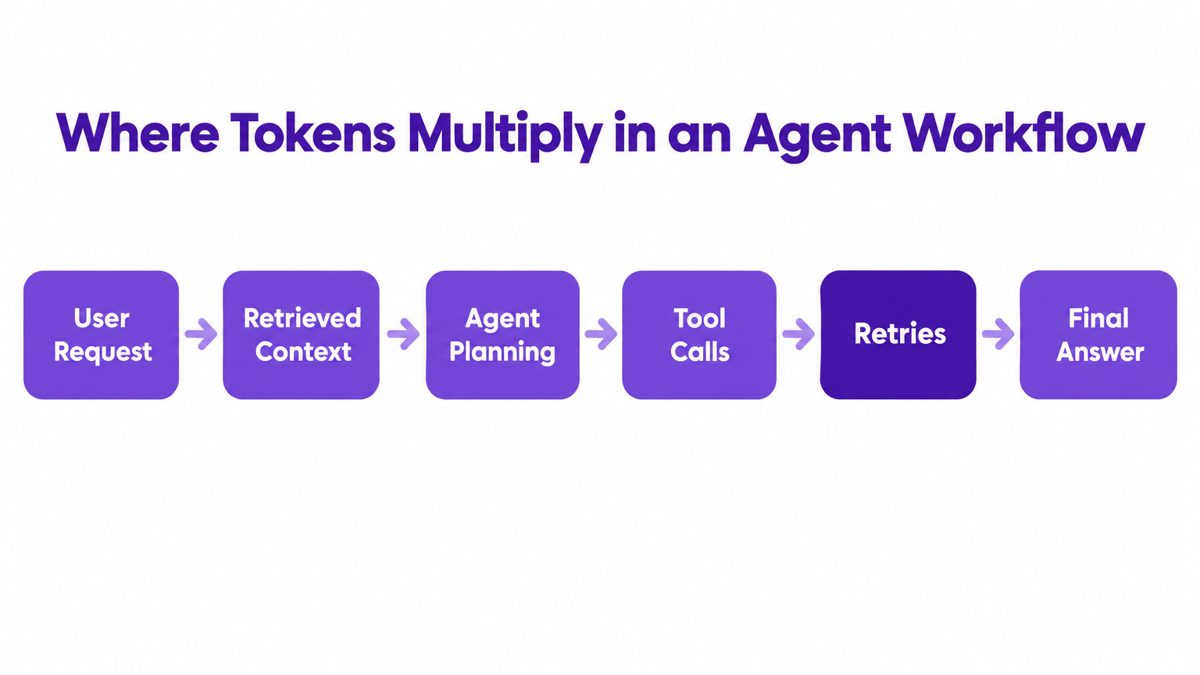
Every stage in that flow adds tokens, and the stages repeat. This is why enterprise AI spend keeps rising even as token prices fall.
Plans, critiques, and summaries that one agent writes are billed as output tokens, then billed again as input tokens when the next agent reads them.
Tool schemas add another layer: each tool definition can cost 200 to 500 tokens per tool, per turn, even when the agent never calls that tool.
The larger RAG cost is rarely the embedding or vector search. It is repeated inference over the retrieved context.
A 20,000-token retrieval set sent to five agents across five turns produces 500,000 input tokens before responses, system prompts, or retries are counted. In one eight-agent workflow, workers re-reading the same shared context accounted for 72% of all input tokens.
Agents that carry history forward pay for that history on every call. A long-running agent session costs more per turn at the end than at the start, even when each question is the same size.
Without summarization or memory limits, a workflow that looked inexpensive in testing becomes costly once users run it for dozens of turns.
Failed tool calls, malformed structured output, timeouts, and weak retrieval all trigger retries, and each retry resends the full context. The longer the context, the more each failure costs.
Unbounded retries are the mechanism behind most agent monitoring incidents, where one loop consumes a month of budget in hours.
| Cost Driver | Where It Hides | Control |
|---|---|---|
| Tokens | Intermediate outputs and tool schemas | Load only the tools each agent needs |
| Context windows | Retrieved passages replayed to every agent | Tighter retrieval and shared context caching |
| Memory | History carried into every turn | Summarization and turn limits |
| Retries | Failures that resend full context | Retry caps and real-time budget limits |
See how AgentNuro maps every token to an agent, model, and project with real-time controls.
Request a DemoPer-token pricing tells Finance what one unit costs, not how many units a task consumes. Two workflows on the same model can differ by an order of magnitude in cost per request.
The better denominator is cost per successful AI task, which counts retries and failed runs against the work actually delivered.
That measure only works when every token has an owner, which requires tagging and attributing every token to an agent, a project, and a cost center.
AgentNuro, CloudNuro's Enterprise AI Adoption Management platform, discovers sanctioned and shadow AI across major model providers and copilots with read-only connections, no agents installed, and no application changes.
AgentNuro maps every dollar and token to a user, project, model, agent, and business unit, so a multi-agent workflow shows up as a cost line with an owner. The approach is detailed in how AgentNuro attributes every AI dollar and how AgentNuro gives visibility into agents and token spend.
AgentNuro also applies real-time controls over model choice, data exposure, token consumption, and runaway spend, and it measures value per token rather than cost per token alone.
Cap retrieved chunks per call and rerank before inserting them. Every passage cut is cut from every agent and every turn.
Cache stable context such as system prompts and shared documents, and pass workers summaries rather than full transcripts.
Load only the tool definitions an agent needs for its role. The token-reduction patterns for prompt engineering apply directly here.
Set a maximum retry count per step and a token budget per task, with an automatic stop when either is reached.
An agent no one approved still consumes tokens. Address the shadow AI agent problem before optimizing the agents you already know about.
As enterprises move from pilots to production agents, cost governance shifts from monthly invoice review to per-task controls that act in real time.
The organizations that scale agents sustainably will treat tokens like any other governed resource: inventoried, attributed, budgeted, and reviewed against the value they deliver.
Multi-agent systems are more expensive because they consume roughly 15x the tokens of a chat interaction for the same request. Orchestration, handoffs, and replayed context drive that multiplier.
The biggest hidden cost in RAG is repeated inference over retrieved context, not embedding or search. The same passages are resent on every call and to every agent that needs them.
Retries increase AI costs because each retry resends the full context of the failed call. Long contexts make every failure more expensive, so retry caps matter most in RAG-heavy workflows.
Enterprises should measure agentic AI cost per successful task, attributed to the agent, project, and business unit that consumed it. CloudNuro's guide to AI pricing and budget planning covers the budgeting side.
AgentNuro maps every dollar and token to a user, project, model, agent, and business unit. It connects read-only, with no agents installed and no application changes.
The hidden cost of RAG and multi-agent systems comes from multiplication: context replayed, history carried forward, and failures retried. Organizations that budget by token price alone will keep missing their forecasts. The better model gives every agent an owner, every token an attribution, and every workflow a budget, within unified visibility across SaaS, cloud, and AI.
See how AgentNuro brings attribution and real-time budget controls to agentic AI.
Request a DemoCloudNuro and AgentNuro give IT and Finance one view of AI usage and spend alongside SaaS and cloud. Every RAG pipeline and multi-agent workflow is discovered, attributed to an owner, and governed with real-time controls over models and token consumption. Teams can also extend governance to Microsoft 365 and Salesforce AI through CloudNuro's AI Custodian.
CloudNuro is a leader in Enterprise AI Adoption Management, providing enterprises with unmatched visibility, governance, and cost optimization. Recognized twice in a row by Gartner in the SaaS Management Platforms and named a Leader in the Info-Tech SoftwareReviews Data Quadrant, CloudNuro is trusted by global enterprises and government agencies to bring financial discipline to SaaS, cloud, and AI. Trusted by enterprises, CloudNuro provides centralized SaaS inventory, license optimization, and renewal management along with advanced cost allocation and chargeback, giving IT and Finance leaders the visibility, control, and cost-conscious culture needed to drive financial discipline.
Request a no cost, no obligation free assessment —just 15 minutes to savings!
Get StartedThe cost of RAG and multi-agent systems is driven less by the price per token than by how many times the same tokens are sent, re-read, and retried.
A single agent consumes roughly 4x the tokens of an ordinary chat interaction, and a multi-agent system roughly 15x, before retries and long retrieved contexts are counted.
This post breaks down the four hidden cost drivers (tokens, context windows, memory, and retries), shows how they compound, and explains how AgentNuro attributes and controls that spend.
A multi-agent system consumes roughly 15 times the tokens of a standard chat interaction for the same user request. That multiplier is the hidden cost of RAG and multi-agent systems, and most AI budgets never model it.
Enterprises budgeted for AI by looking at per-token prices. Agentic architectures changed the math: one request now triggers retrieval, planning, tool calls, handoffs between agents, and retries, and each step resends context the model has already read.
CIOs see the architecture, CFOs see the invoice, and FinOps leads are asked to explain the gap between them. That gap is why TokenOps has become a FinOps practice in its own right.
This post explains where tokens multiply in RAG and multi-agent workflows, what each driver costs, and the controls that keep agentic AI spend measurable and attributable.
Get a no-cost assessment of the token spend behind your RAG and agent workloads.
Get Free Savings AssessmentThe token multiplier is the ratio between the tokens a workflow actually consumes and the tokens a single question and answer would use. Most model APIs are stateless, so every call resends the system prompt, retrieved passages, tool definitions, and prior outputs.
A single agent consumes roughly 4x the tokens of a chat interaction. A multi-agent system consumes roughly 15x, about 3.75 times a single agent, because an orchestrator delegates, reads worker outputs, requests revisions, and synthesizes.
Every stage in that flow adds tokens, and the stages repeat. This is why enterprise AI spend keeps rising even as token prices fall.
Plans, critiques, and summaries that one agent writes are billed as output tokens, then billed again as input tokens when the next agent reads them.
Tool schemas add another layer: each tool definition can cost 200 to 500 tokens per tool, per turn, even when the agent never calls that tool.
The larger RAG cost is rarely the embedding or vector search. It is repeated inference over the retrieved context.
A 20,000-token retrieval set sent to five agents across five turns produces 500,000 input tokens before responses, system prompts, or retries are counted. In one eight-agent workflow, workers re-reading the same shared context accounted for 72% of all input tokens.
Agents that carry history forward pay for that history on every call. A long-running agent session costs more per turn at the end than at the start, even when each question is the same size.
Without summarization or memory limits, a workflow that looked inexpensive in testing becomes costly once users run it for dozens of turns.
Failed tool calls, malformed structured output, timeouts, and weak retrieval all trigger retries, and each retry resends the full context. The longer the context, the more each failure costs.
Unbounded retries are the mechanism behind most agent monitoring incidents, where one loop consumes a month of budget in hours.
| Cost Driver | Where It Hides | Control |
|---|---|---|
| Tokens | Intermediate outputs and tool schemas | Load only the tools each agent needs |
| Context windows | Retrieved passages replayed to every agent | Tighter retrieval and shared context caching |
| Memory | History carried into every turn | Summarization and turn limits |
| Retries | Failures that resend full context | Retry caps and real-time budget limits |
See how AgentNuro maps every token to an agent, model, and project with real-time controls.
Request a DemoPer-token pricing tells Finance what one unit costs, not how many units a task consumes. Two workflows on the same model can differ by an order of magnitude in cost per request.
The better denominator is cost per successful AI task, which counts retries and failed runs against the work actually delivered.
That measure only works when every token has an owner, which requires tagging and attributing every token to an agent, a project, and a cost center.
AgentNuro, CloudNuro's Enterprise AI Adoption Management platform, discovers sanctioned and shadow AI across major model providers and copilots with read-only connections, no agents installed, and no application changes.
AgentNuro maps every dollar and token to a user, project, model, agent, and business unit, so a multi-agent workflow shows up as a cost line with an owner. The approach is detailed in how AgentNuro attributes every AI dollar and how AgentNuro gives visibility into agents and token spend.
AgentNuro also applies real-time controls over model choice, data exposure, token consumption, and runaway spend, and it measures value per token rather than cost per token alone.
Cap retrieved chunks per call and rerank before inserting them. Every passage cut is cut from every agent and every turn.
Cache stable context such as system prompts and shared documents, and pass workers summaries rather than full transcripts.
Load only the tool definitions an agent needs for its role. The token-reduction patterns for prompt engineering apply directly here.
Set a maximum retry count per step and a token budget per task, with an automatic stop when either is reached.
An agent no one approved still consumes tokens. Address the shadow AI agent problem before optimizing the agents you already know about.
As enterprises move from pilots to production agents, cost governance shifts from monthly invoice review to per-task controls that act in real time.
The organizations that scale agents sustainably will treat tokens like any other governed resource: inventoried, attributed, budgeted, and reviewed against the value they deliver.
Multi-agent systems are more expensive because they consume roughly 15x the tokens of a chat interaction for the same request. Orchestration, handoffs, and replayed context drive that multiplier.
The biggest hidden cost in RAG is repeated inference over retrieved context, not embedding or search. The same passages are resent on every call and to every agent that needs them.
Retries increase AI costs because each retry resends the full context of the failed call. Long contexts make every failure more expensive, so retry caps matter most in RAG-heavy workflows.
Enterprises should measure agentic AI cost per successful task, attributed to the agent, project, and business unit that consumed it. CloudNuro's guide to AI pricing and budget planning covers the budgeting side.
AgentNuro maps every dollar and token to a user, project, model, agent, and business unit. It connects read-only, with no agents installed and no application changes.
The hidden cost of RAG and multi-agent systems comes from multiplication: context replayed, history carried forward, and failures retried. Organizations that budget by token price alone will keep missing their forecasts. The better model gives every agent an owner, every token an attribution, and every workflow a budget, within unified visibility across SaaS, cloud, and AI.
See how AgentNuro brings attribution and real-time budget controls to agentic AI.
Request a DemoCloudNuro and AgentNuro give IT and Finance one view of AI usage and spend alongside SaaS and cloud. Every RAG pipeline and multi-agent workflow is discovered, attributed to an owner, and governed with real-time controls over models and token consumption. Teams can also extend governance to Microsoft 365 and Salesforce AI through CloudNuro's AI Custodian.
CloudNuro is a leader in Enterprise AI Adoption Management, providing enterprises with unmatched visibility, governance, and cost optimization. Recognized twice in a row by Gartner in the SaaS Management Platforms and named a Leader in the Info-Tech SoftwareReviews Data Quadrant, CloudNuro is trusted by global enterprises and government agencies to bring financial discipline to SaaS, cloud, and AI. Trusted by enterprises, CloudNuro provides centralized SaaS inventory, license optimization, and renewal management along with advanced cost allocation and chargeback, giving IT and Finance leaders the visibility, control, and cost-conscious culture needed to drive financial discipline.
Request a no cost, no obligation free assessment - just 15 minutes to savings!
Get StartedWe're offering complimentary ServiceNow license assessments to only 25 enterprises this quarter who want to unlock immediate savings without disrupting operations.
Get Free AssessmentGet Started




CloudNuro Corp
1755 Park St. Suite 207
Naperville, IL 60563
Phone : +1-630-277-9470
Email: info@cloudnuro.com






Recognized Leader in SaaS Management Platforms by Info-Tech SoftwareReviews